$22.3 Billion Pre-Sells Your Savings
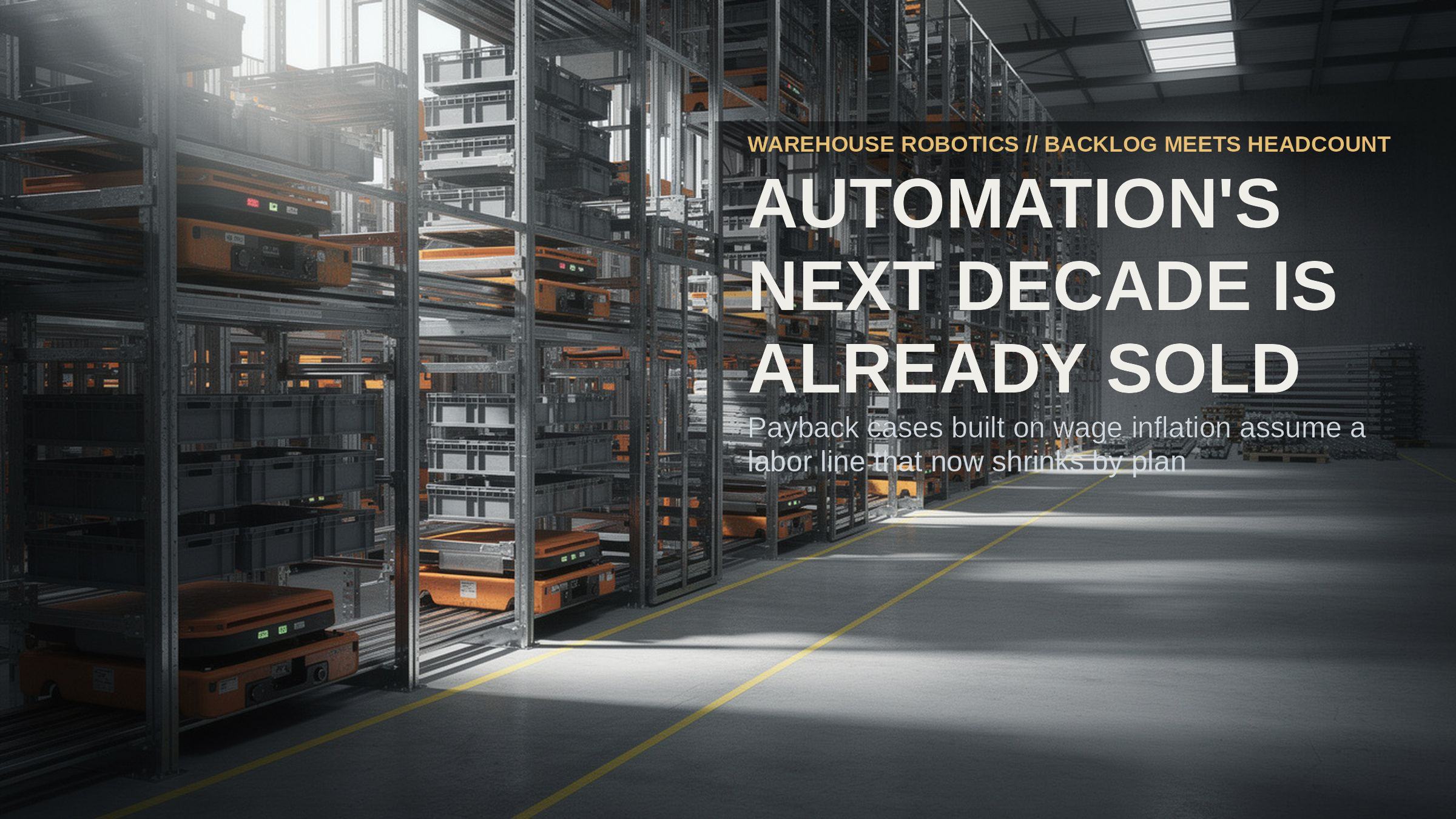
Symbotic closed its fiscal year with $22.3 billion of booked robot work already signed [1]. Four days earlier, Procter & Gamble told investors it will remove 20–30% of its product-supply workforce by 2030 as machines take over the manual jobs [4]. The automation for the next decade is largely sold. The headcount it was priced against is already a budget line. If your payback case still counts on wage inflation, it was built for a market both announcements say is ending.
At a glance
This article reads Symbotic’s $22.3 billion contracted backlog against Procter & Gamble’s plan to cut up to 30% of its supply staff by 2030. It concerns operations leaders signing long robot deals, and it argues the savings those deals assume are now planned cuts.
Signed before the cuts
The dates landed inside one week. Symbotic filed its annual report on November 23, 2026, covering a fiscal year that ended September 26 [1]. Its backlog — unperformed work under existing contracts, in the company’s own words — stood at $22.3 billion, mostly warehouse systems not yet built [1]. About a sixth becomes revenue next fiscal year [1]. The same day, the earnings call added nearly $7 billion more, set to enter the booked orders next quarter through the new Walmart deal [3].
The contracts behind that number go back almost a decade. Walmart signed a master agreement with Symbotic in 2017, widened it in 2021 to 25 distribution centers, then extended it in 2022 to cover all 42 [1]. That one buyer now holds about 47% of the booked orders and 87% of this year’s revenue [1]. The pricing is built to protect the seller, too: the company says the backlog is structured to hold its gross profit targets even if inflation or supply-chain prices climb [1].
On November 19, Procter & Gamble put the buyer side on the record. Luc Reynaert, its chief product supply officer, told investors that 20% to 30% of the product-supply workforce will be gone by 2030, contractors included, as manual work gives way to machines [4]. The company already runs autonomous production at more than 15 sites and plans to scale that during the fiscal year ending June 30, 2027 [4]. The same presentation promised to free employees “for higher-value work” [4]. That promise now shares a page with a 20–30% headcount cut. Two descriptions of one workforce, and only one of them is a plan.
I read the two filings as one trade seen from each end. The labor savings behind a decade of robots were priced in the shortage years, when wages kept rising and workers kept leaving. What is being delivered now is different: headcount falling by plan, at a named buyer, on a dated schedule. A payback case built on wage inflation assumes a labor line that keeps costing more. The new reality is a line that shrinks on purpose. Once the cut lands, the savings stop compounding — and the capital is still owed.
By the numbers
- $22.3 billion: Symbotic’s booked backlog at fiscal year-end, mostly systems not yet delivered [1].
- $3.57 billion: the backlog slice that becomes revenue next fiscal year, by my division of the company’s figures [1].
- 47% of backlog: held by Walmart, which also supplied 87% of this year’s revenue [1].
What I’d watch
The people closest to this are re-reading contracts, not celebrating. One buyer carries nearly half the booked orders [1], so I’d watch whether next year’s revenue slips as install crews run out of Walmart sites to convert. The second question is renewal pricing. The seller’s margin is protected through inflation [1], which means a buyer whose labor savings fade cannot expect the contract to share the pain. This desk has argued before that the wage floor you assume sets the robot’s payback — and that floor is now falling on the buyer’s side of the ledger. I would re-run any payback case on a labor line being cut by plan before signing anything that long. Exits stay hard after signing: an industry survey in late October put 94% of buyers calling a switch prohibitively expensive [5]. The labor pool itself is thinning on the government’s count too [6].
The catch
My reading, held loosely: neither document proves what the pairing implies. The backlog records demand already signed; it says nothing about whether the promised productivity arrives, and the filing warns that contracts can be adjusted for inflation and revalidation [1]. Procter & Gamble’s cut is a plan running to 2030, not a done deal, and the productivity projection is the company’s own [4]. What both documents do establish is direction. Capital is contracted forward; headcount is committed down. Whether the savings hold at contract prices, or fade after the first cuts, is a question neither company has to answer. The buyer pays either way.
Related reading
- Your Fleet’s 8.3-Year Bill: The Wave Nobody Reserves For — more on Supply Chain & Operations
- $6 Billion, Same 25 Buildings — more on Supply Chain & Operations
- Your Robot Budget’s 39-Year Gap — more on Supply Chain & Operations
Sources
- [1] Symbotic Inc., “Form 10-K for fiscal year ended September 26, 2026” — https://www.sec.gov/Archives/edgar/data/1837240/000183724026000049/sym-20260926.htm
- [2] Symbotic Inc., “Symbotic Reports Fourth Quarter and Fiscal Year 2026 Results”, Nov. 23, 2026 — https://ir.symbotic.com/news-releases/news-release-details/symbotic-reports-fourth-quarter-and-fiscal-year-2026-results
- [3] Symbotic Q4 FY2026 earnings call transcript, Nov. 23, 2026 — https://stockanalysis.com/stocks/sym/transcripts/707599-q4-2026
- [4] Antone Gonsalves, “Procter & Gamble plans supply chain workforce cuts as automation expands”, Supply Chain Dive, Nov. 24, 2026 — https://www.supplychaindive.com/news/procter-gamble-plans-supply-chain-workforce-cuts-as-automation-expands/875533/
- [5] Exotec, “One in Four Supply Chain Leaders Regret Their Warehouse Automation Decision, and 94% Say Switching Would Be Prohibitively Expensive”, Oct. 28, 2026 — https://www.exotec.com/news/one-in-four-supply-chain-leaders-regret-their-warehouse-automation-decision-and-94-say-switching-would-be-prohibitively-expensive
- [6] Productiv, “November 2026 Labor & Logistics Indicators” (BLS September 2026 preliminary data) — https://getproductiv.com/insights/labor-logistics-indicators/2026-11
- [7] “Warehouse Payback: $17.00, Not $17.95”, aichieve.net — https://aichieve.net/wage-floor-sets-robot-payback/