Skip to content

Supply chain

Inventory Record Accuracy Calculator

Size the safety stock your records force you to hold: demand and lead-time variance plus the error in the bin count itself, the working capital it ties up, and the margin lost to stockouts the ERP says cannot happen.

Runs in your browser Audited by Gini Loh
Instrument panel Deterministic · nothing leaves the page
What the records cover3
skus
$
$

What a lost sale costs you, not what it sells for.

Demand and supply4
units
σ/day
days
σ days
What the records get wrong4

Share of SKU records with a variance, as a decimal: 0.65 is 65%.

Overstatement is what cuts orders at the pick face.

days

Record error as a share of mean on-hand. An assumption, not a measurement.

Service level and carrying cost2
Target service level

Capital, storage and shrink together, as a decimal: 0.22 is 22%.

Dead cash in buffer$11m$2.4m a year to hold
Phantom stockouts$5.4mmargin a year, orders cut at the face
Extra units per SKU184.4215 → 400

Buffer stock against a data error

184 extra units per SKU is $11.1m of working capital covering a record, not a demand.

Record error widens the effective deviation from 130.9 to 243.0 units. It costs $2.4m a year to hold, and the pick face loses $5.4m of margin while the ERP says the stock is there.

Working capital the records force you to hold65% of records wrong
90% service level$8.5m
$19m with these records, $10m with audited ones
95% service level$11m
$24m with these records, $13m with audited ones
97.5% service level$13m
$29m with these records, $16m with audited ones
99% service level$16m
$34m with these records, $18m with audited ones
99.5% service level$17m
$38m with these records, $20m with audited ones
Excess over accurate records
Working capital by service level
Service levelCurrent recordsAccurate records
90%$19m$10m
95%$24m$13m
97.5%$29m$16m
99%$34m$18m
99.5%$38m$20m
Where the money isσ 130.9 → 243.0 units
Stock held against the records$11m
working capital, recovered once the records are fixed
Holding cost a year$2.4m
Margin lost to phantom stock$5.4m
9,321 stockout events a year
  • Record error is modelled as 50% of mean on-hand (630 units per SKU at these inputs). It is an assumption about how the error is spread, not a measurement.
  • Dead cash is working capital tied up, not a one-off release. It is recovered once, and the holding cost is what it costs every year until the records are fixed.

When a vendor is selling the fix

An automated storage system is often quoted against the cost of inaccuracy. CaseProof re-runs the vendor's payback on your own costs, so the storage is priced against cycle counting and slotting first.

Open CaseProof ↗

Operator notes

How to run it

    ['\t\t\t\t
  1. 1. Enter SKU count, unit cost and the margin a lost sale costs you.
  2. ', '\t\t\t\t
  3. 2. Set daily demand and supplier lead time with their swings — this is the buffer you would hold anyway.
  4. ', '\t\t\t\t
  5. 3. Enter the share of records that disagree with the shelf and how long a phantom takes to notice.
  6. ', '\t\t\t\t
  7. 4. Pick the service level you promise, then read the excess at that level rather than the total.
  8. ', '\t\t\t\t
  9. 5. Compare the dead cash against the annual cost of counting, and fix the records before the storage.
  10. ']

Model logic

σ over lead time = √(lead time × demand swing² + demand² × lead-time swing² + record error²). Record error is the inaccuracy share × mean on-hand × spread, and safety stock is Z × σ. Dead cash is the extra units across all SKUs at unit cost.
FAQ

Why is record error written as units rather than a rate?

A rate multiplied by velocity does not act like a deviation. The error is an amount of stock: the inaccuracy share times the mean on-hand, spread by an assumption stated on the page. Defined that way it moves the answer, which is the point.

What is a phantom stockout?

The ERP shows stock on hand, the shelf is empty, and the replenishment order that should have been raised never was. The order gets cut at the pick face, and the margin on those units is gone.

Is dead cash a one-off saving?

No. The stock is released once when the records are fixed, and the holding cost is what it costs every year until then. Both figures are on the page because they answer different questions.

Why compare against a 5% baseline?

Because a cycle-counted location is expected to sit under five percent variance. The comparison is not zero error, it is the accuracy a counted warehouse already reaches.

Related dispatch

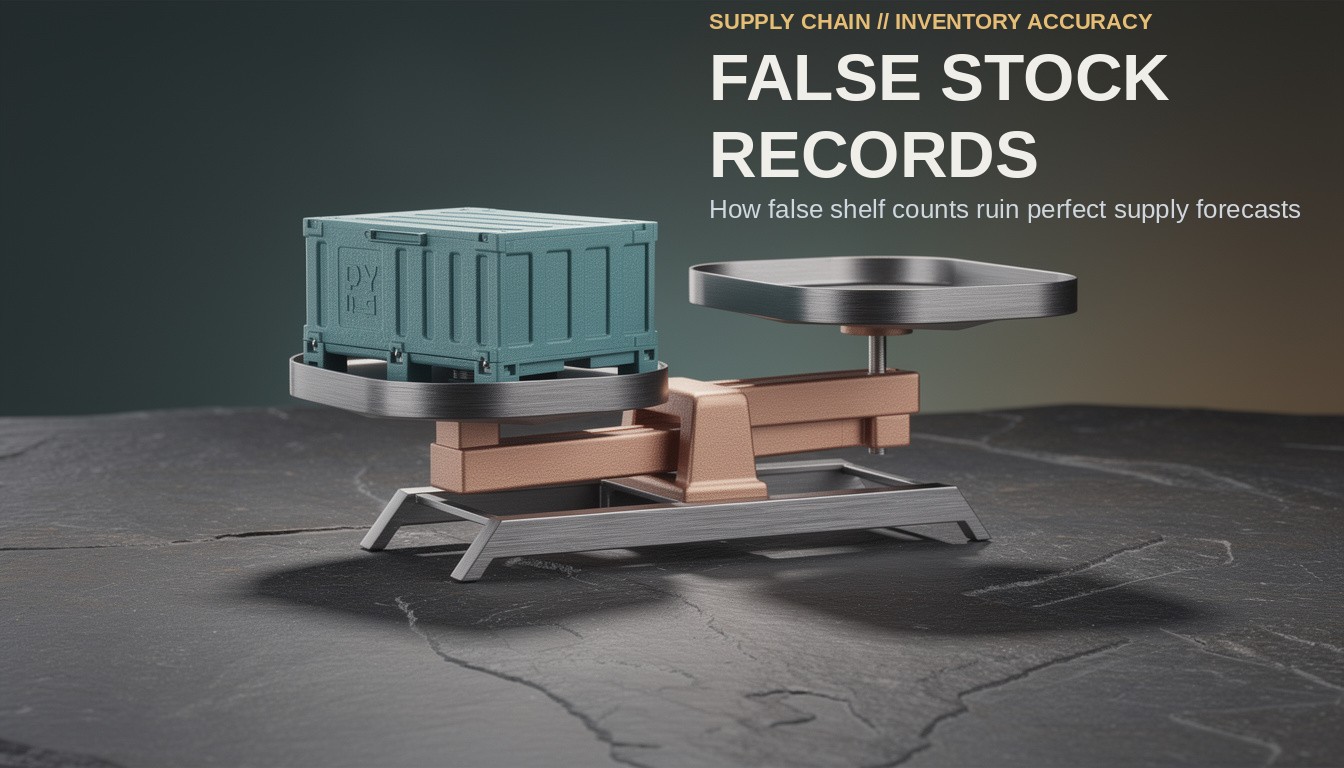
False Stock Records. A precision industrial balance scale out of equilibrium, with a heavy polymer module on one side and an empty tray on the other.

Your Stock Records Are 65% Wrong

At one large retailer, 65% of stock records failed to match the shelf count, and that gap cut profit by more than ten percent.

Read dispatch