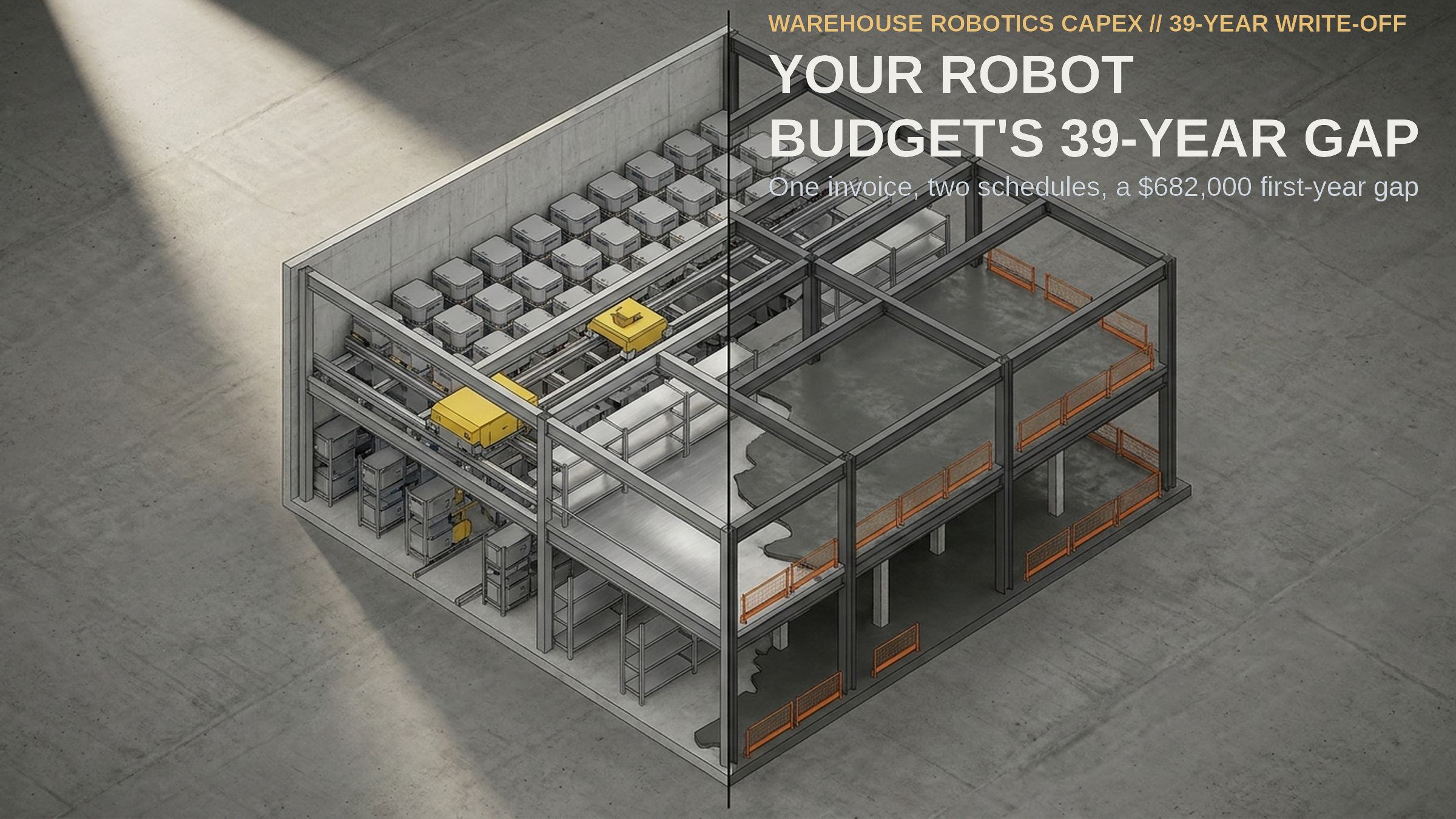
Federal tax law splits a robot budget into machines and building work, and the write-off gap between the two is 39 years. New robots and interior work can be written off in full in the year they are ready for their specific use [1][2]. Money spent on a bigger building, or on its frame, falls on the long schedule and comes back a few percent at a time [1]. Same project, same cases moved: a $700,000 building line returns about $17,950 a year on the long schedule, or all of it in one year on the short one — roughly $682,000 of difference in year one [1][3].
Two schedules, one invoice
The long schedule is not aimed at warehouses. A building is written off over 39 years, and its first year counts from the middle of the month it enters service [1]. The code also has a middle class for work done inside one. It is called qualified improvement property: interior work put in service after the building itself, written off over 15 years [1].
Three kinds of spend drop out of that class:
- Enlargement — adding floor area outside the existing footprint is not interior work [1].
- Elevators and escalators — these are excluded from the interior class [1].
- Internal structure — the building’s internal frame is also excluded [1].
A second rule then decides whether a purchase goes at once or over years. The extra first-year allowance reaches property written off over 20 years or less [1][4]. That covers the robots and the 15-year interior work. It does not reach the long building schedule [1].
So one weekend of building work can produce two answers. A slab poured inside the existing footprint, to carry a goods-to-person grid — the shelving system robots move to people — is interior work. An extension built to house the same grid is not [1].
My read is that operators have treated this as the accountant’s problem. It is not. The accountant sees the invoice and the closing papers, not the drawings. The drawings are where the class is decided. A steel deck, the platform that holds the robots, is described one way inside the existing shell and another way if it adds floor area and braces the frame. That difference decides which schedule gets the line [1][3].
Where the split is decided
The buyers who come out cleanly do one thing before the purchase order. They break the estimate into robots, interior work and shell work, and keep the three lines apart through approval. A single all-in price does not merge them in law, but it does hide which line is which until someone reads the drawings [1].
What I keep coming back to is how much of this is a calendar question. Property is in service when it is ready and available for its specific use [2]. The tax service’s own example is a machine that arrived last year but could not run until this year. It counts as placed in service this year [2]. A robot that lands in December and is running in February belongs to February. A group that books a December delivery as a December write-off is counting on something the rules do not give.
There is a second clock, and it only matters where the first-year allowance does not apply. If late-year additions cross a legal threshold, the whole year moves to a rule that assumes each asset arrived mid-quarter [1]. That trims the first-year number on the robots too. It is also the rule that catches a used fleet, because the allowance needs original use to begin with the buyer — the buyer must be the first one to use the equipment [1].
What is left for those machines is the option to deduct the cost in one year. It has a cap, a phaseout and an income limit [3].
By the numbers
- 100 percent — First-year allowance: property written off over 20 years or less, whose original use begins with the buyer, can go in full in the year it is ready for use [1][2].
- $2,500,000 — Expensing ceiling: the election to expense is capped there, starts to shrink above $4,000,000 of cost, and cannot exceed the business’s own taxable income [3].
- 40 percent — Fourth-quarter switch: when more than 40 percent of a year’s asset value enters service in the last three months, the mid-quarter rule applies to all of that year’s equipment [1].
The catch
No article can classify a building from a desk, and I would not trust one that tried. The code gives a test: is the spend for an enlargement, an elevator or escalator, or the internal frame [1]? A steel deck can fall on either side, depending on what it is bolted to and whether it adds floor area. Whoever reads the drawings against the statute decides. The point is the size of the question, so it gets asked before the invoice rather than after the return.
The allowance also carries a date. Public Law 119-21 restored the full first-year allowance for property acquired and put in service after January 19, 2025, and the expense ceiling is indexed for later years [2][3]. The operative number in two years will be the current version, not this one. All of it is federal, and a state that departs from the federal allowance can change the answer without touching the code.
One more limit is worth carrying. A write-off cuts taxable income, so its value depends on income that exists. A loss year defers the benefit rather than creating it, and the election to expense is limited to what the business earns [3]. The cash a write-off returns is real, but it is a share of a cost already paid. Whether these machines should be owned at all is a separate argument, and the own-versus-rent arithmetic is where that one starts.
At a glance
- The shift: one automation budget, two assets — machines on a one-year schedule, building work on a 39-year one.
- The number: about $682,000 of first-year write-off on a $700,000 building line.
- The risk: what the spend is for decides the class, and the drawings decide that.
Related reading
- $200,000 Robots: Your Seller Won’t Stay — more on Supply Chain & Operations
- Higher Rates Meet Historically Lean Inventories — more on Supply Chain & Operations
- Your Robot Ratio Fails — more on Supply Chain & Operations
Sources
[1] 26 U.S.C. § 168 — Cornell Legal Information Institute — https://www.law.cornell.edu/uscode/text/26/168 [2] Internal Revenue Service, Publication 946 (2025), How To Depreciate Property — https://www.irs.gov/publications/p946 [3] 26 U.S.C. § 179 — Cornell Legal Information Institute — https://www.law.cornell.edu/uscode/text/26/179 [4] 26 C.F.R. § 1.168(k)-2, additional first year depreciation deduction — https://www.ecfr.gov/current/title-26/section-1.168%28k%29-2