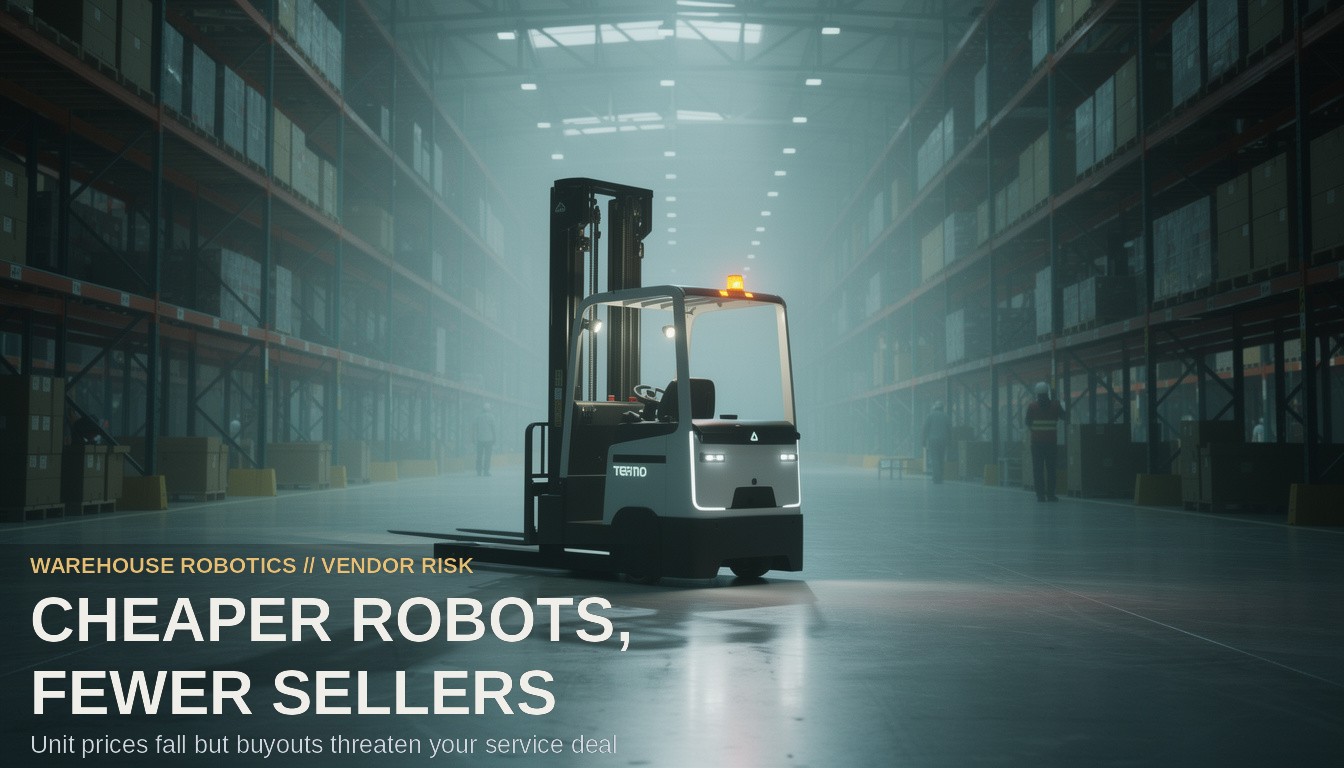
An automated forklift costs $100,000 to $200,000 a unit today. Seegrid says the model it is building for warehouses, due in early 2027, will sell for about half the price of its factory machine [1][2]. Six days before that report, Symbotic bought its third automation company this year [3][4]. The robots are getting cheaper. The seller behind them won’t stay the same.
The big picture:
The price falls for a simple reason. Warehouse work pays less than factory work, so the robot must clear a lower bar to pay for itself. Labor can make up 50% to 65% of warehouse running costs [2]. That math can justify a robot. It cannot justify a factory-priced one.
The seller list shrinks for a plainer reason. Most automated forklift projects are still “small, more like pilots”, and most buyers start “with a handful of trucks” before reaching dozens, if they scale at all [2].
Firms that stay small get bought or exit. Symbotic keeps buying the pieces: forklifts for trailer docks, warehouse software, and now sortation [3][5].
My read is that both trends land on the same bill. The unit price keeps getting better. The service deal is quietly moving to a new owner.
By the numbers
- $100,000 to $200,000 — Price per robot: the upfront cost of one automated forklift system, with hardware, software and integration included [1].
- About half — Warehouse model plan: the price Seegrid says its early-2027 warehouse model will carry against its factory machine [2].
- 2,500-plus — Robots deployed: Seegrid’s fleet, spread across hundreds of facilities and more than 50 customers [2].
- $5.9B to $14.5B — Market forecast: Grand View’s 2026-to-2033 view for the autonomous forklift market, a 13.7% compound annual rate [1].
What I’d watch:
Three details decide whether a cheaper machine is also the cheaper decision.
- Who holds the service deal: Symbotic says cellumation keeps its own name, its Bremen headquarters, its founders and its customers [3][4]. That is a brand promise, not a contract term. I’d watch what happens to a repair agreement when a later deal folds the firm in.
- Whether the date holds: the early-2027 timing and the half-price target come from Seegrid’s chief sales officer, not from a price list [2]. A vendor cutting price for a cheaper labor market is also a vendor choosing what to leave out.
- Whether the pilots become fleets: 2,500 robots across hundreds of facilities means most sites run a handful [2]. I would want the count of sites running dozens.
There is a second reading, and it is friendlier to the buyer. A buyout can improve service. A larger owner has more field techs, more spare parts and more cash than a startup. The real question is whether the service level survives the sale.
The catch
The part I keep circling is Cutter & Buck, the strongest case against my worry. The clothing brand opened a second automated distribution center in Grand Prairie, Texas, this month. The grid holds 50,502 storage bins and 32 AutoStore robots, plus 13 ports. It was built to move 1,256 bins an hour [6][7]. A simulation averaged 1,284 [6][7].
Its first grid went live in Renton, Washington, in July 2023. That site held more than 34,000 bins and 54 robots [6]. That site was later expanded by 9,962 bins [6]. The brand stayed with the same seller and the same installer because the first project worked. Then it used years of run data to design the second site in a new way [6][7]. That is what staying with one seller looks like when it pays off.
The flip side is the sellers’ own math. Seegrid’s chief sales officer estimates that more than 80% of automation-only startups will not survive as standalone companies [2]. “Standalone” is the word that matters, because a buyout is a survival route. Fox Robotics, which makes autonomous forklifts for trailer docks, took that route in February when Symbotic bought it [3][5]. A buyer who installed a Fox fleet in 2025 now owns a fleet whose road map belongs to a different company. That company also sells sortation and storage systems.
Symbotic has not published comparative performance figures for the technology it just bought [5]. That is not a knock on the deal. It is a note on what a buyer can check in year one.
At a glance
- The Big Shift: Automated forklifts cost $100,000 to $200,000 a unit, but Seegrid says a warehouse version due in early 2027 will carry about half the price of its factory machine. In the same week, Symbotic bought its third automation company of the year, adding sortation to a system that already covers forklifts and warehouse software.
- Why It Matters: The unit price is the part of a payback a buyer can watch fall. The company that services the asset, supplies the parts and writes the software is the part being consolidated. That tie is harder to renegotiate once the fleet is on the floor.
- What I’d Watch: Whether the service tie survives the sale, and whether the cheaper machine arrives as promised.
- Service deal handoffs: who takes on the legal obligation when a seller is bought, and what a buyer can claim if service drops.
- Warehouse model pricing: whether 2027 brings a real price list, or a stripped-down setup.
- Fleet growth: whether sites move from a handful of trucks to dozens, which is where a real payback shows up.
- The Catch: The half-price plan is a seller forecast, not a firm quote. Buyouts can improve service, and Cutter & Buck’s second grid, built on its first platform, shows that staying with one seller can pay off.
Related reading
- $62M Says You Never Buy Robots — more on Supply Chain & Operations
- 4 Warehouses Halve Stock. Yours Won’t — more on Supply Chain & Operations
- Amazon Builds the Robots; Walmart Builds for What They Can’t… — more on Supply Chain & Operations
Sources
[1] Grand View Research, “Autonomous Forklift Market Size & Share Report, 2026–2033” — https://www.grandviewresearch.com/industry-analysis/autonomous-forklift-market-report [2] DC Velocity, “Automated forklifts: Hot or not?” (Toby Gooley, 2026-10-19) — https://www.dcvelocity.com/material-handling/automated-forklifts-hot-or-not [3] Symbotic Inc., “Symbotic Announces Acquisition of cellumation, Advancing Next-Generation Sortation Technology for the Global Supply Chain” (2026-10-13) — https://www.symbotic.com/news/symbotic-announces-acquisition-of-cellumation-advancing-next-generation-sortation-technology-for-the-global-supply-chain [4] cellumation GmbH, “New Chapter: Symbotic acquires cellumation” (2026-10-13) — https://cellumation.com/newsroom-en/press-release/new-chapter-symbotic-acquires-cellumation [5] A3 / Automate.org, “Symbotic Is Building More Than Warehouse Robots. Its Latest Acquisition Shows Why.” (2026-10-17) — https://www.automate.org/motion-control/industry-insights/symbotic-is-building-more-than-warehouse-robots-its-latest-acquisition-shows-why [6] Kardex, “Cutter & Buck Opens New Texas Distribution Center, Expanding Strategic Automation Partnership with Kardex” (2026-10-13) — https://kardex-us.prezly.com/cutter-buck-opens-new-texas-distribution-center-expanding-strategic-automation-partnership-with-kardex [7] Supply Chain Dive, “Cutter & Buck eyes fulfillment boost with second automated distribution center” (2026-10-19) — https://www.supplychaindive.com/news/cutter-buck-eyes-fulfillment-boost-with-second-automated-distribution-cen/833237