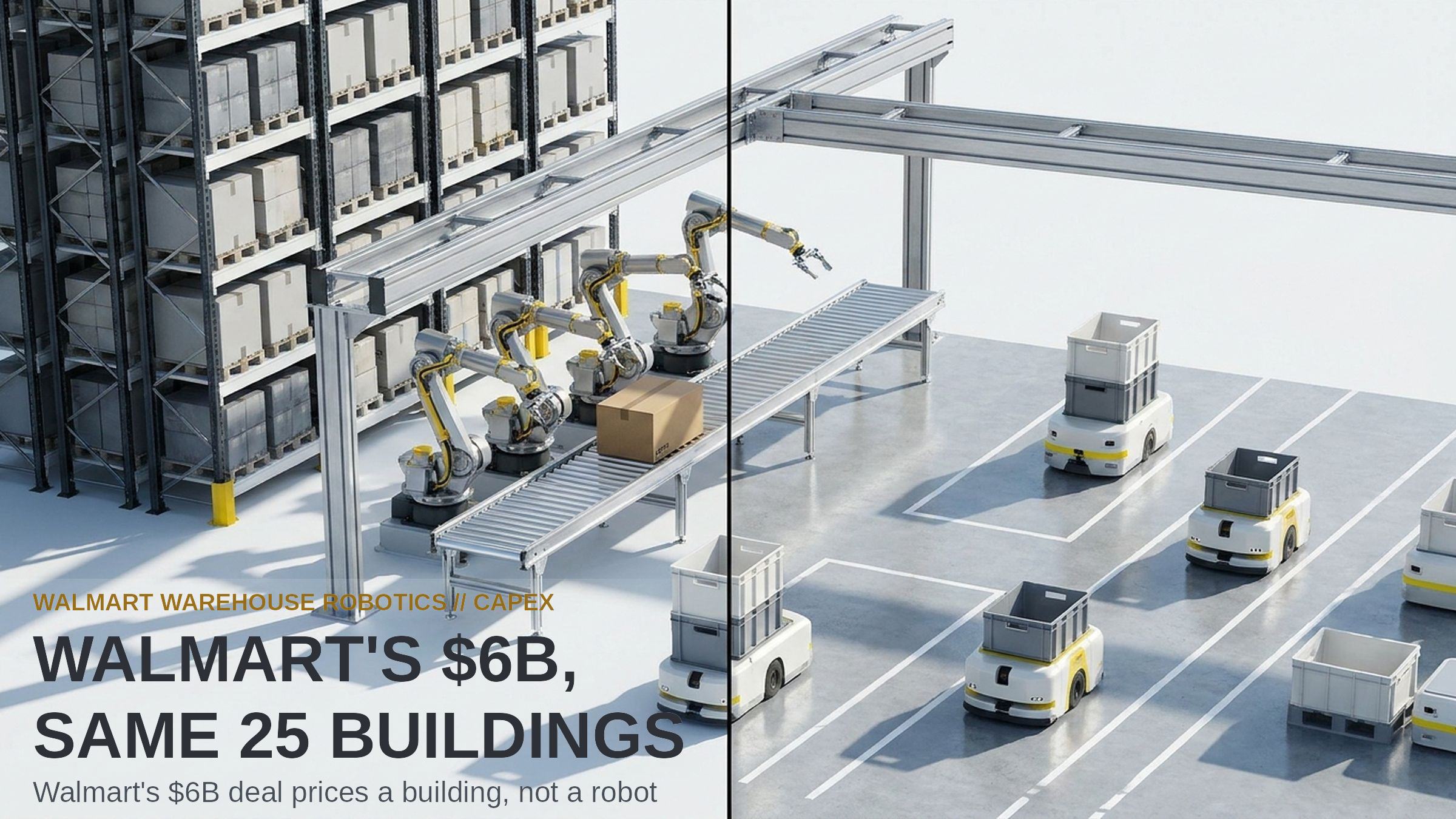
Walmart signed a second automation deal this week: about $6 billion for more robots and software in 25 of the same buildings, U.S. regional distribution centres (RDCs). Those sites were already inside a retrofit plan the company set in 2022 to run eight years [1][5][6]. The retailer wants them to hold stock for online orders as well as restock stores, because the additions are aimed at e-commerce inventory [5]. The release gives no price for a single building, no count of machines and no savings figure [1][3]. Open it for a benchmark and you find one number, not the number an operator buys in.
A building price, a machine index
The new spend is not more of the same system. Symbotic calls the additions capabilities: BreakPack, which picks single items instead of full cases, and SymMicro, a small fulfilment system for online orders [1]. Walmart says the aim is stock for e-commerce, more storage and faster flow [5]. The earlier layer moved cases from the dock into store-bound loads. The new one handles single items for online orders, a different job on the same floor, and a different cost driver. I read the release three times looking for a price per building, and it is not there.
The Association for Advancing Automation (A3) counted 10,989 industrial robots ordered in the third quarter, worth $723.5 million. That is up 24.8% in units and 26.1% in value on a year earlier, the strongest quarter of 2026 [7]. Orders for the first nine months reached 28,984 units worth about $1.89 billion [8]. One figure prices a machine, and the other prices a building.
A3’s data cover industrial robots only; a spokesperson confirmed they do not include automated mobile robots nor humanoids [9]. Autonomous mobile robots (AMRs) are the units that carry totes and shelves around a warehouse floor, the class a system like Walmart’s runs on. So the 24.8% is led by semiconductor, auto parts and plastics orders, up 97.6%, 90.4% and 67.7%. Food and consumer goods orders fell 23.7% over the same three months [10].
By the numbers
- 25 of 42 — Buildings already in the plan: the 2022 programme covers all 42 RDCs over eight years, and the new layer lands in 25 of them, four years in [13][14]
- $65,800 — Average industrial robot: the quarter’s $723.5 million of orders spread across 10,989 units, a machine price beside a building commitment [7]
- 23.7% — Food and consumer goods decline: the demand group nearest store restocking fell while the headline index rose 24.8% [10]
What buyers ask before layer two
What I find hard to square is the line between the two layers, because that is where a contract either holds or leaks. Buyers who add a second phase inside a live building ask three things, and the release answers none of them.
The first question is which jobs the installed system already does and which jobs the new money adds, quoted as separate lines. Without that split, a seller can present the whole system’s output as the case for the increment. The buyer then has no way to test whether the increment earned its share.
The second question is a figure per case handled at each layer. A system price cannot be compared with another system price when the buildings differ in volume, and that is the only kind of price on offer here. The earlier read on Walmart’s automation numbers makes the same point from the other side: what a fleet can lift decides which sites it suits, not the size of the order.
Third, the seller’s own numbers arrive on a public date. Symbotic reports fourth-quarter and full-year results on 23 November [15]. That report is the first check on how the deal turns into backlog and revenue. The buyer’s cost is fixed in the contract while the seller’s economics arrive later this month, in a document the buyer does not sign.
The catch
What I cannot get past is the network behind Walmart’s case. Twenty-five buildings on a weekly restocking rhythm give a fixed system a large, steady volume to spread its cost across. That density is the asset the deal buys into. Treated as a template, the same spend at three buildings buys the same machines with a third of the flow, and with no payback at all.
The honest limit sits in the unit nobody prints. Cost per case moved, set against the years you write it off, settles whether a second layer earns its capital. Neither the vendor’s release nor the order index states it. The figure an operator carries to finance is a guess about how hard the system runs, what the orders look like and how wages move. The largest commitment in this category this week does not print that guess either.
At a glance
The shift: Walmart’s second automation layer is priced per building while the industry’s demand index is priced per machine. The number: 25 of the 42 RDCs in a retrofit plan that runs eight years. The risk: neither source prints cost per case moved, so any payback on this deal is a guess.
Related reading
- Amazon Builds the Robots; Walmart Builds for What They Can’t… — more on Supply Chain & Operations
- $200,000 Robots: Your Seller Won’t Stay — more on Supply Chain & Operations
- $62M Says You Never Buy Robots — more on Supply Chain & Operations
Sources
[1] Symbotic/Walmart expanded commercial agreement, 2026-10-29 — https://www.symbotic.com/news/walmart-and-symbotic-expand-commercial-agreement-to-support-supply-chain-transformation [3] Supply Chain Dive, “Walmart commits $6B to up distribution center automation with Symbotic”, 2026-11-02 — https://www.supplychaindive.com/news/walmart-commits-6b-to-up-distribution-center-automation-with-symbotic/873356 [5] Symbotic/Walmart release, statement of purpose (e-commerce upstream inventory, storage capacity, product flow) — https://www.symbotic.com/news/walmart-and-symbotic-expand-commercial-agreement-to-support-supply-chain-transformation [6] Supply Chain Dive, “Walmart to deploy Symbotic’s AI tech in all regional distribution centers”, 2022-05-23 — https://www.supplychaindive.com/news/Walmart-and-Symbotic-partnership-automate-distribution-centers/624235 [7] DC Velocity, “North American robot orders increased 24.8% in third quarter”, 2026-10-30 — https://www.dcvelocity.com/material-handling/robotics/north-american-robot-orders-increased-24-8-in-third-quarter [8] DC Velocity, nine-month order totals, same report — https://www.dcvelocity.com/material-handling/robotics/north-american-robot-orders-increased-24-8-in-third-quarter [9] Manufacturing Dive, “North American robot orders grew nearly 25% in Q3”, 2026-10-30 — https://www.manufacturingdive.com/news/north-american-robot-orders-grew-nearly-25-percent-q3-2026-a3/873300 [10] Manufacturing Dive, industry breakdown of Q3 orders, same report — https://www.manufacturingdive.com/news/north-american-robot-orders-grew-nearly-25-percent-q3-2026-a3/873300 [13] Walmart, “Chain Reaction: We’re Partnering with Symbotic to Bring High-Tech Automation to Our Supply Chain”, 2021-07-14, with the May 2022 expansion note — https://corporate.walmart.com/news/2021/07/14/chain-reaction-were-partnering-with-symbotic-to-bring-high-tech-automation-to-our-supply-chain [14] Supply Chain Dive, “Walmart to deploy Symbotic’s AI tech in all regional distribution centers”, 2022-05-23 (eight-year retrofit) — https://www.supplychaindive.com/news/Walmart-and-Symbotic-partnership-automate-distribution-centers/624235 [15] Symbotic, “Symbotic Announces Date for Reporting Fourth Quarter Fiscal Year 2026 Financial Results”, 2026-10-29 — https://www.symbotic.com/news/symbotic-announces-date-for-reporting-fourth-quarter-fiscal-year-2026-financial-results-2