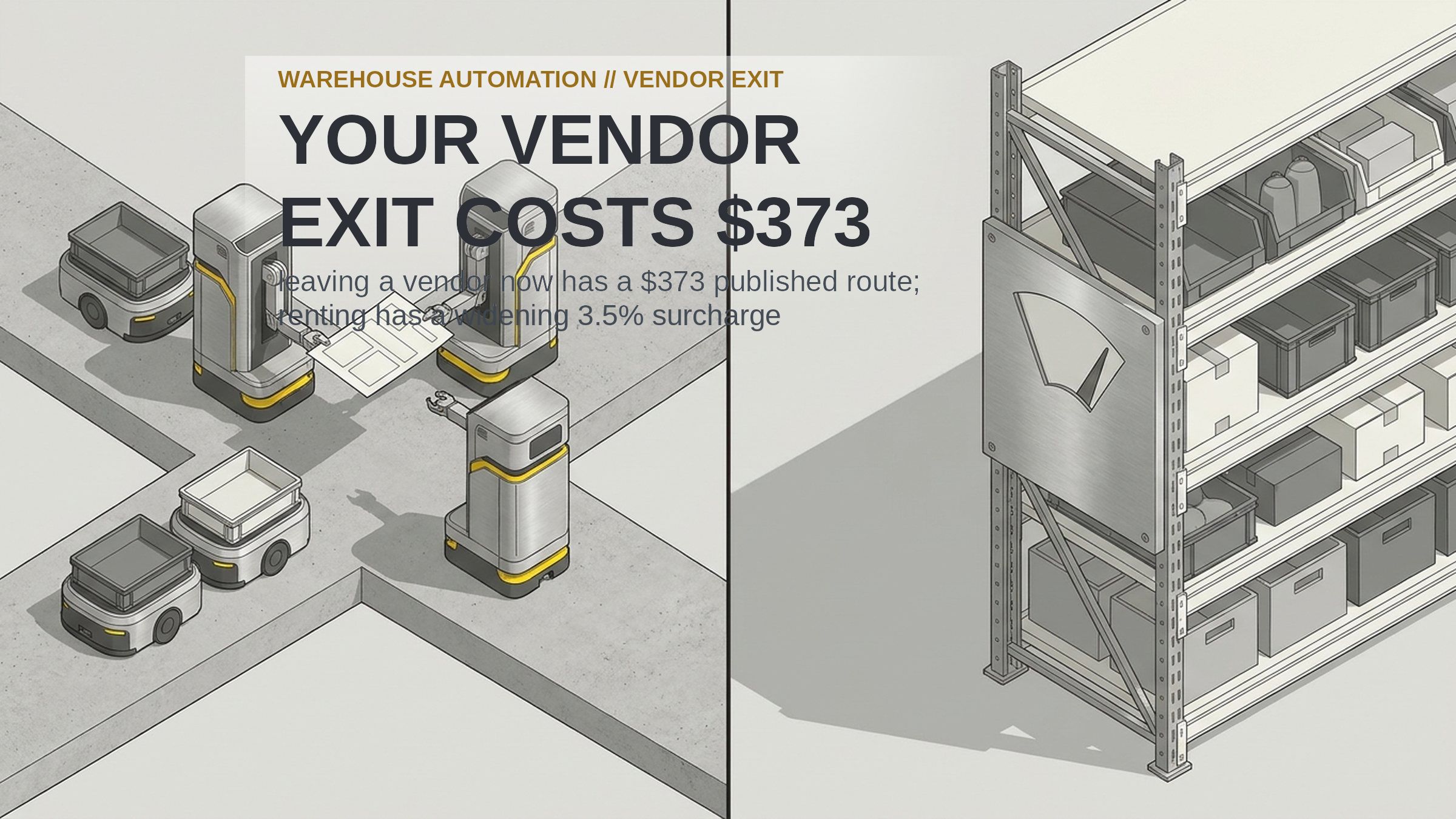
On 2 November the automation trade group A3 published a $373 document on how robots from different makers share one floor [1]. Three days later, Amazon told sellers its 3.5% fuel and logistics surcharge will widen [3]. From 1 February 2027 the charge will also hit the transport fees on the services Amazon sells for bulk storage and refill. The two notices price the opposite halves of one choice: what it costs to exit a vendor mid-life, and what it costs if you never own the machines at all. Most payback models treat the first as hopeless and the second as fixed.
At a glance
- The shift: a standard now lets a buyer specify robots from several makers.
- The number: 3.5%, the surcharge on the rented option, widening next year.
- The risk: the standard binds no vendor, while the percentage binds you.
A document and a percentage
The work began in 2020, when MassRobotics put robot makers and their buyers in one room [5]. No single supplier could cover every task, and mixed floors stalled whenever two fleets met. That group put out an open standard in 2021, then handed the problem to a panel of the International Organization for Standardization (ISO) [5]. The result is ISO 21423:2026, and nearly 90 people from more than a dozen countries wrote it [1].
The text is narrow in what it asks. Robots, the software that hands them work, and other machines swap six fields: location, speed, direction, condition, tasking and availability [1]. The reach is wider than the fleet. The text also covers lifts, doors, alarms and enterprise resource planning (ERP) systems [2]. That puts the people who own a building’s doors and its stock records inside the robot purchase.
What I keep returning to is where the cost lands. It lands on integrators, whose margin is the work of making unlike machines behave as one.
Witron, a German builder of fixed crane-and-shuttle warehouses, answered on 17 November by buying Solwr Robotics [4]. Solwr is a Norwegian firm of about 50 staff, and its Grab robot picks cases weighing up to 30 kilograms. Witron says the robot joins its own systems “within a very short time and with minimal investment” [4]. That is a low price of entry and a costly way out. A buyer who signs that line has bought the lock the standard was written to break.
Amazon’s notice is the mirror image. A surcharge it added in April 2026 already sits on Fulfillment by Amazon (FBA) fees in the U.S. and Canada [3]. From February it also covers the fees for bulk storage and refill.
Nothing on that side is an asset. There is no purchase price, no write-down schedule and no salvage value. There is a rate, and Amazon says it “will keep reviewing the surcharge as conditions change” [3]. The same notice moves storage toward paying for time. The storage utilization surcharge ends, and the aged-inventory charge folds into one rate by age.
By the numbers
- 3.5% of fulfilment fees: the surcharge Amazon added in April and widens next year [3].
- $0.19 a unit: the average FBA fee rise Amazon applies from 15 January 2027 [3].
- Six shared fields: location, speed, direction, condition, tasking and availability, the data robots must swap [1].
What to ask for now
The buyers closest to this were in the room early. General Motors runs robots from several brands at sites worldwide, its automation chief Steven DuMont said in an A3 editorial [6]. Their case was plain. Mixed floors stall when two fleets cannot agree who goes first at a crossing aisle, and a person has to walk out and clear it [6]. What I find hard to square is how little of that reaches a purchase order. The question that follows is which line a buyer writes: the one that names an interface, or the one that promises a whole layout.
On the rent side, the start date is the only line a model can hold, and the payback tool most operators already run has no field for it at all. On the owned side, the six fields are a checklist that costs nothing to ask for. Symbotic reports fourth-quarter results on 23 November, the next hard number on what a large buyer pays per building [7].
The catch
The gap sits between a document existing and a document working. A3 states plainly that the ISO text is not a safety standard, and it describes messages rather than results [2]. No vendor is named as having built it.
Nothing creates a resale market for a used fleet, and nothing forces an integrator to open an interface it would rather keep shut. The other leg is no firmer. A share can fall as fast as it rose, and Amazon’s own words leave the rate under review [3]. The document buys the right to name an interface. The rate buys the seller the right to set its level later. My reading is that which matters more depends on how much of your last integration bill was interface work, and that figure sits in your own files rather than in either notice.
Related reading
- $200,000 Robots: Your Seller Won’t Stay — more on Supply Chain & Operations
- $6 Billion, Same 25 Buildings — more on Supply Chain & Operations
Sources
- [1] Association for Advancing Automation, “New ISO Interoperability Standard Helps Mobile Robots from Different Vendors Work Together”, 2 November 2026 — https://www.automate.org/robotics/news/new-iso-interoperability-standard-helps-mobile-robots-from-different-vendors-work-together
- [2] Association for Advancing Automation, “New! Standard for Mobile Robot Interoperability” (ISO 21423:2026 product page) — https://www.automate.org/robotics/new-interoperability-standard-iso-21423-2026
- [3] Max Garland, “Amazon to expand fuel and logistics surcharge to more services”, Supply Chain Dive, 17 November 2026 — https://www.supplychaindive.com/news/amazon-to-expand-fuel-and-logistics-surcharge-to-more-services/874693/
- [4] David Priestman, “Witron Acquires Warehouse Robotics Firm”, Logistics Business, 17 November 2026 — https://logisticsbusiness.com/materials-handling/robotic-picking/witron-acquires-warehouse-robotics-firm
- [5] MassRobotics, “From MassRobotics Working Group to Global Standard: ISO 21423 and AMR Interoperability” — https://www.massrobotics.org/from-massrobotics-working-group-to-global-standard-iso-21423-and-amr-interoperability
- [6] MarketScale Newsroom, “ISO 21423 lets mixed-vendor mobile robots share a floor”, MarketScale — https://www.marketscale.com/industries/industrial-iot/a-373-iso-standard-lets-mobile-robots-from-different-vendors-share-a-floor
- [7] Symbotic, “Symbotic Announces Date for Reporting Fourth Quarter Fiscal Year 2026 Financial Results”, 29 October 2026 — https://www.symbotic.com/news/symbotic-announces-date-for-reporting-fourth-quarter-fiscal-year-2026-financial-results-2