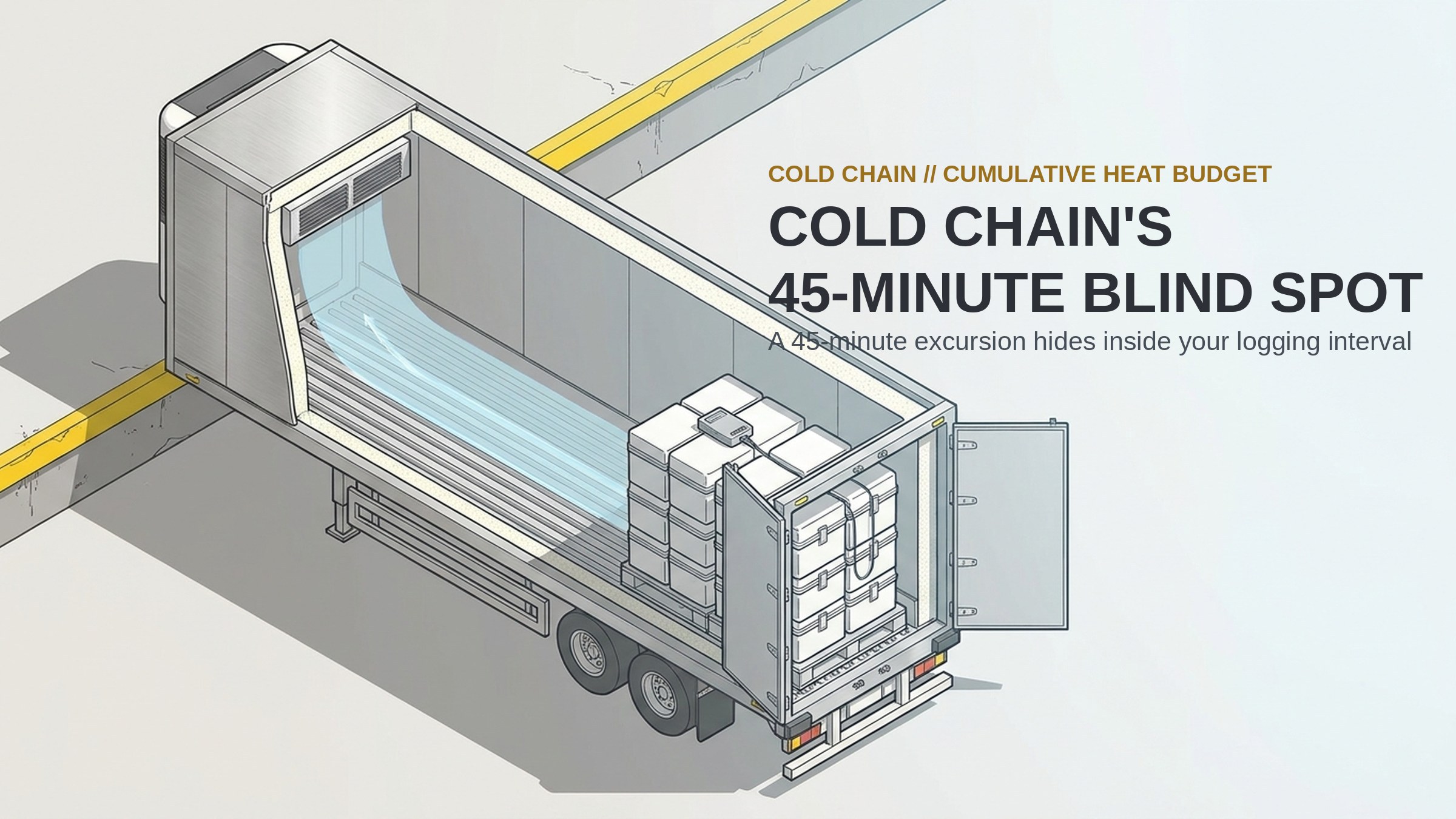
A pallet of refrigerated medicine reaches a depot, and someone has to clear it for release. The only evidence is a logger that rode along, and most teams read that record the wrong way. Cold-chain exceptions turn on a cumulative heat budget, not the highest reading [1]. A hot hour drives more chemical damage than a warm one, so the sum beats the peak. One refrigerated trailer’s log makes the arithmetic concrete: three readings at 5°C, 8°C and 14°C average 9.0°C, but their mean kinetic temperature (MKT) is 9.85°C [1]. That gap is your cold chain blind spot, and a two-hour logging interval can hide a 45-minute excursion inside it [1].
One peak hides the damage
The Arrhenius equation, the chemistry rule that makes a hot hour more damaging than a warm day, is the weighting behind that total [1]. At the MKT value, the total damage over the period equals the damage from the readings actually taken [1]. A hot reading therefore does not dominate by size; it dominates by the harm it can do.
The allowance that follows is a budget, not a ceiling. A product held between 2°C and 8°C may sit in a band up to 15°C for no more than 24 hours [1]. The conditions are that its MKT stays at or below 8°C, and that no reading falls below 2°C or rises above 15°C. A product held between 20°C and 25°C may not go above 40°C for more than 24 hours, as long as its MKT stays at or below 25°C [2]. Both rules describe spending, not a spike test.
My read is that this turns an exception from an event into an account balance. A load at 9°C for six hours and a load at 15°C for twenty minutes are different withdrawals from different budgets. Neither one is “an alarm” in the sense most pipelines mean.
By the numbers
- 80% — Potency floor: a shelf-life period holds while more than 80% of the active ingredient is still potent [3]. What remains is the product’s budget; one method page lists 8–25°C for 12 months plus 25–40°C for 28 days.
- 99.5% — Releases automated: a vendor quotes a joint talk with a drug maker [4]. It reports 99.5% of product releases running with no human input, so the output is a release call, not a cleared alert.
- 0.5°C — Logger accuracy: connected trackers measure to within plus or minus 0.5°C or better [2]. Accuracy has stopped being the limit in the sum.
Where the budget goes
The supply chain architects I watch set three things, and only one of them is usually treated as architecture. The window follows the storage class [1]: a cold product gets a day, and a room-temperature one gets a month or the days its holder keeps it. The logging cadence — how often the logger records a reading — is the setting nobody owns, even though the MKT standard names its own example interval [1]. At two hours, a 45-minute excursion never enters the record at all; at 15 minutes it does.
The third is the budget, and it belongs to the product. A logistics provider cannot carry a separate rule for every item it moves [3]. That is the method page’s own case for loading limits into the logger or the database and letting the maker hold the allowance. It is a data-contract choice, not a dashboard setting, and it decides whether a release can run without a person.
Two jobs sit in the same pipeline, and they want different clocks. A live alert exists to save the load, so it should fire on the fastest signal the device can send. The release call exists to defend the load, so it needs a full window and a clean record. Most towers wire the first job to the second job’s data, and then leave the second job with no owner.
The catch
What I find hard to square is how easily a good sum becomes an excuse. The standard is explicit that MKT judges an excursion after the fact, not that it licenses normalising a lane already out of control [1]. A lane that spends its whole budget every week is a repair job wearing a compliance form.
One caveat on sourcing: both chapters are sold as document files this desk’s verifier cannot read. Every figure above therefore comes from a page that quotes the chapter, not from the chapter itself. The legal floor is firmer: warehouses must watch temperature and humidity so that a drug’s identity, strength, quality and purity hold [5]. A shipper of food that needs cold must state the conditions and show they were kept [6]. Neither line tells you what the budget is.
The record that answers a claim is the same exception log this desk has priced for its retention (Your exception log owes 5 years). A budget summed over a window nobody kept is a number with no defence behind it.
At a glance
The shift: cold-chain exception logic moves from paging on a temperature-limit breach to summing a heat budget over the standard’s window. The number: 9.85°C, the mean kinetic temperature of readings that average 9.0°C. The risk: a cadence coarser than the excursion erases the evidence a release depends on.
Related reading
- 4 Warehouses Halve Stock. Yours Won’t — more on Supply Chain & Operations
- Warehouse Payback: $17.00, Not $17.95 — more on Supply Chain & Operations
- Your Charger Gap Buys 16 Robots — more on Supply Chain & Operations
Sources
[1] Tive, “Mean Kinetic Temperature (MKT) in Pharma: USP Formula & Disposition Guide” — https://www.tive.com/blog/mean-kinetic-temperature-pharma [2] World Courier, “How to prevent temperature excursions in pharmaceutical cold chain” — https://www.worldcourier.com/insights/high-fidelity-data-and-rtlm-key-in-preventing-temperature-excursions [3] ELPRO, “Stability Budget Explained” — https://www.elpro.com/en/learn/stability-budget-explained [4] Controlant, pharma cold-chain monitoring platform — https://www.controlant.com/ [5] 21 CFR 211.142(b), warehousing conditions — https://www.ecfr.gov/current/title-21/chapter-I/subchapter-C/part-211/subpart-D/section-211.142 [6] 21 CFR 1.908, requirements for transportation operations — https://www.ecfr.gov/current/title-21/chapter-I/subchapter-A/part-1/subpart-O/section-1.908