
At a Glance — Part 1 of 8: The Automated CFR Protection Loop Series
-
The Blind Spot: Standard Case Fill Rate treats recoverable backorders like permanent cuts, while ERP reason codes only record who closed the order—not what broke.
-
The Fix: Measure matured failures with Advanced CFR (aCFR) and archive bitemporal snapshots that preserve what each system knew before the cut happened.
-
The Payoff: Fill-rate tracking shifts from a Monday-morning blame ritual into an early-warning radar that rescues open orders before the truck leaves the dock.
By the Numbers
-
18.75-Point Swing: A single 1,000-case order reads as a 75.0% failure under Standard CFR, but 93.75% under aCFR once 200 recoverable backorder cases are separated from the 50 permanently cut.
-
6 Overwrite Stages: Touchpoints from Order Entry to Post-Mortem Audit where reps, batch jobs, and pickers overwrite the exact same ERP reason-code field.
-
7 Drift Traps: Systemic ways reason codes detach from reality—from midnight batch defaults (
NS) to “one-delivery” rules that close short orders with no code at all. -
2 Mandatory Clocks: Every snapshot requires both Valid Time (the week being planned) and Load Time (when the system knew it) to defeat hindsight bias.
We no longer have to treat order cuts as a historical autopsy.
Most enterprises already sit on a goldmine of operational telemetry across their ERP, Advanced Planning Systems (APS),and warehouse ledgers—yet they only inspect that data after the truck leaves the dock short, filtered through overwritten reason codes that obscure what actually went wrong. Flip that model on its head—by capturing bitemporal decision-point snapshots of what each function knew while it still had time to act—and supply chain analytics transforms from a backward-looking scorecard into an active, self-healing protection loop.
Imagine catching an unfulfillable order on Day 1—eight days before its requested delivery date—because your system instantly spots that it was routed to an unsupplied warehouse and switches it to an alternate plant with surplus stock.Imagine intercepting an EDI order for a discontinued SKU before it ever enters your backlog, or spotting a regional warehouse deficit six days before an overnight Backorder Processing (BOP) run strips 70% of a customer’s confirmed volume while a sister facility sits on 3× target inventory.
Replace the sentence in the CFR 1 intro that says “Over this eight-part series, we build that exact blueprint…” with this first-person framing:
What follows across this eight-part series is my reference architecture and working blueprint for solving this problem from the ground up. Rather than pitching an off-the-shelf vendor product or rehashing a retrospective case study, I designed this system to connect the dots between real-world SAP/APS failure patterns, bitemporal data engineering, and multi-agent AI orchestration. Across the series, we stress-test the design against four composite order-cut scenarios—moving from decision-point SQL diagnostics to an orchestrated team of 11 domain-specialist AI agents that rescue at-risk orders and repair master data:
-
CFR 1 (This Article): Why Reason Codes Lie: Fix Fill Rate With Decision-Point Snapshots — Exposing the math illusions of standard CFR, the 7 mechanisms of attribution drift, and the bitemporal snapshot foundation.
-
CFR 2: Rescue Open Orders Fast: The Two-Speed Case Fill Rate Loop — Separating immediate pre-shipment rescue (Fast Loop) from governed master-data repair (Slow Loop).
-
CFR 3: Stop Zero-ATP Cuts: Align ERP Sourcing and Automate Plant Switches — Dissecting sourcing-network mismatches and automating rescue with S/4HANA aATP Alternative-Based Confirmation.
-
CFR 4: Ghost SKUs Kill Fill Rate: Block Obsolete Orders Before They Enter — Stopping discontinued products from masquerading as unexplained shortages via pre-order lifecycle gates.
-
CFR 5: Fix Network Stock Imbalances Before Backorder Runs Cut Your Orders — Catching localized DC deficits opposite network surpluses and exposing silent delivery closures.
-
CFR 6: Trace Factory & Raw Material Cuts Without Falling for Data Traps — Enforcing strict epistemic guardrails (
NULL ≠ zero output) and conditional BOM tracing into raw and packaging procurement. -
CFR 7: Build a Bitemporal Evidence Layer to Diagnose Order Cuts in SQL — Architecting the 8-question short-circuiting diagnostic tree and 10-domain Snowflake evidence schema.
-
CFR 8: Scale Order Rescue With an 11-Agent Supply Chain Team — Blueprinting the Case Orchestrator, 3 concurrent execution pods (
A1–A11), and human-governed action workflows.
Author’s Note:
The Automated CFR Protection Loop is my independent reference architecture and system design created to explore how bitemporal data warehousing and domain-specialist AI agents can solve chronic enterprise fill-rate blind spots. The orders, SKUs, and network topologies across CFR 1–8 are composite stress-test scenarios modeled on real-world SAP and Advanced Planning System mechanics—not proprietary data from any single organization.
In this opening installment, we start at the foundation: why the numbers and reason codes on your current fill-rate dashboard are pointing you in the wrong direction.
When a recorded ERP reason code lands on a shorted order line, it rarely reflects the earliest controllable root cause.Instead, it records how the order was administratively closed days after the real failure occurred. To stop fixing the wrong problems—and start rescuing orders—you have to fix two foundational flaws in your fulfillment architecture: how you calculate the failure, and how you capture the evidence.
Go Deeper
Every Monday morning, supply chain executives sit in the same post-mortem meeting, staring at a Case Fill Rate (CFR) waterfall chart that confidently assigns blame for last week’s order cuts.
Forty percent is bucketed under “Planning.” Another twenty-five percent sits under “Production,” followed by a stubborn tail of “Business Decision” and “Not Specified.” Armed with that chart, leadership tells Demand Planning to fix the forecast, tells Customer Service to clean up rejection codes, and waits for next Monday.
Yet the cuts never stop. Why? Because a recorded ERP reason code is an operational event, not a forensic verdict.
In modern enterprise supply chains, the code stamped on a shorted order line rarely reflects the earliest controllable root cause. Instead, it records how the order was administratively closed days after the real failure occurred. If you want to stop fixing the wrong problems—and start rescuing orders—you have to fix two foundational flaws in your fulfillment architecture: how you calculate the failure, and how you capture the evidence.
1. The Math Illusion: Standard CFR vs. Advanced CFR (aCFR)
Before diagnosing why an order was cut, you have to establish whether a permanent service failure actually occurred.
Traditional Case Fill Rate divides total shipped cases by total ordered cases. While simple to compute, this formula contains a major operational blind spot: it treats an active, recoverable backorder identically to a permanently canceled cut. When you blend pending execution with completed failures, planners either panic over open volume that is still on track to ship, or they miss the true severity of closed cuts.
To isolate matured fulfillment performance, high-performing supply chains use Advanced Case Fill Rate (aCFR).Instead of lumping all unshipped volume together, aCFR separates every customer order into three distinct states:
-
PDQ (Planned Delivery Quantity): Total cases requested by the customer.
-
UOQ (Unfulfilled Open Quantity): Cases still active or backordered that remain potentially fulfillable.
-
UCQ (Unfulfilled Closed Quantity): Requested cases permanently lost because the order line was closed,canceled, rejected, or shipped short.
$$
\text{Advanced CFR (aCFR)}\% = 100 \times \left[ 1 – \frac{\sum \text{UCQ}}{\sum (\text{PDQ} – \text{UOQ})} \right]
$$
By subtracting UOQ from PDQ in the denominator, aCFR evaluates only the demand whose fulfillment window has matured. And because it is calculated as a ratio of sums rather than an unweighted average of order-level percentages,high-volume orders carry proportional mathematical weight.
One Order, Five Service Truths
Imagine a customer places an order for 1,000 cases. By the initial requested date, 750 cases have shipped, 200 cases remain open on an active backorder awaiting a confirmed cross-dock transfer, and 50 cases were rejected and closed short.
Depending on which metric your executive dashboard displays, leadership hears five completely different stories about that single order:
The Executive Takeaway: Never rely on a single fill rate number in isolation. Review aCFR, Standard CFR, vCFR, and OTIF side-by-side. Use aCFR to audit permanent system failures after close-down, while using UOQ (Open Backorders) as the live hunting ground for your pre-shipment rescue team.
2. A Reason Code Is an Event, Not a Verdict
Once those 50 closed-short cases hit your aCFR report, the natural instinct is to group them by their ERP rejection reason code to find out who broke the promise.
Here is the problem: in nearly every ERP, a single order rejection reason-code taxonomy is overwritten by customer service reps, automated batch jobs, warehouse pickers, and financial analysts across six completely different stages of the order lifecycle:
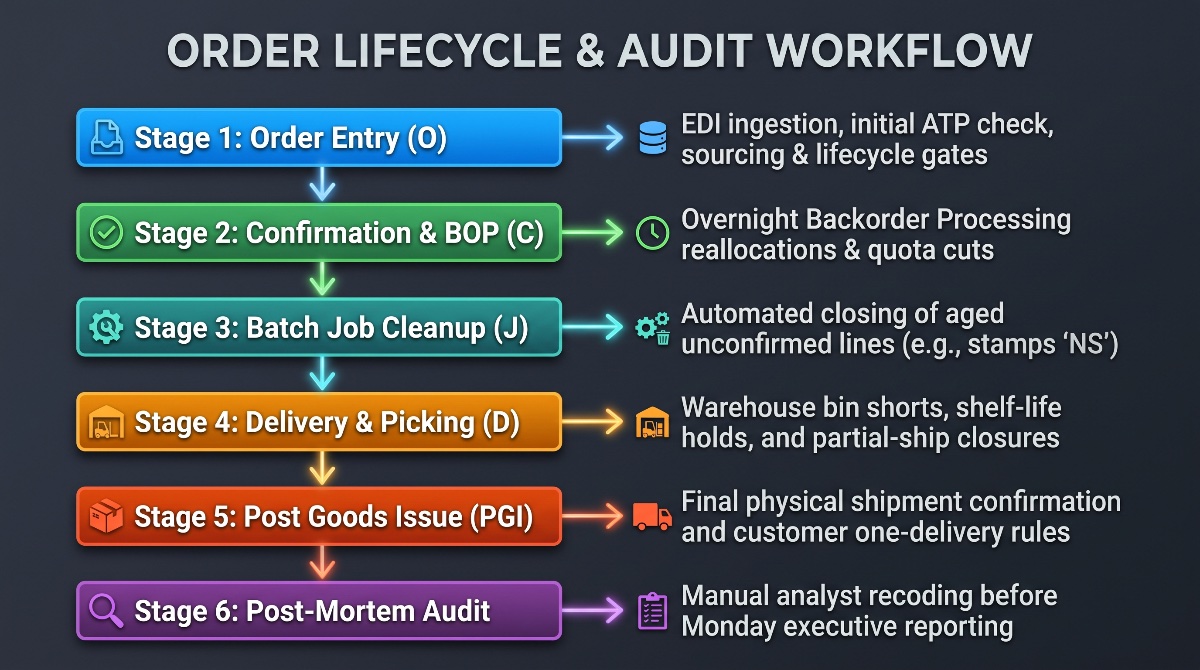
Because humans, bots, and batch jobs all write to the same field across time, the code that survives at Stage 3 or Stage 4 is merely the last administrative touchpoint. Treating that code as root cause is like blaming the coroner for the death.
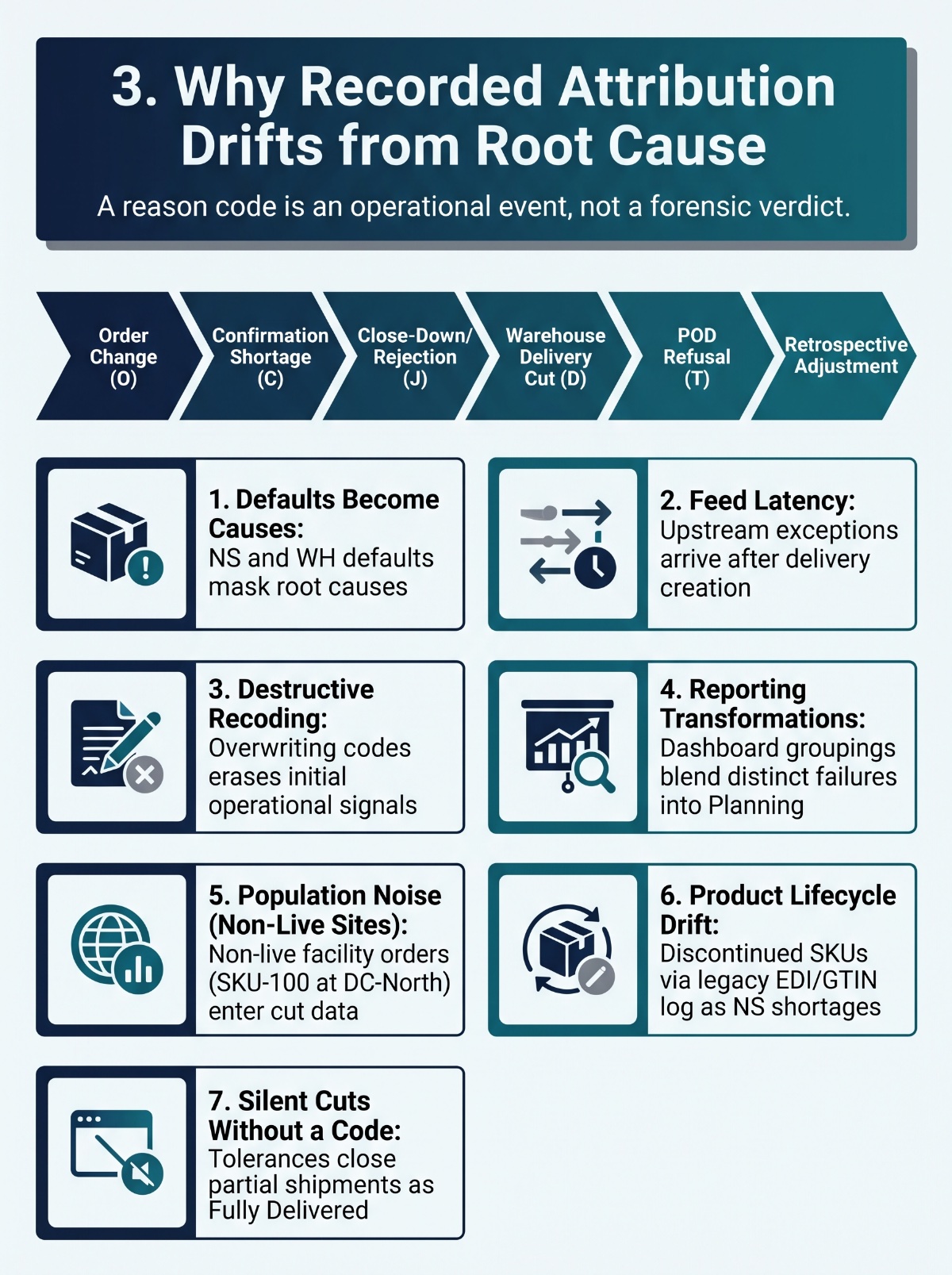
3. The 7 Mechanisms of Attribution Drift
When we audited real-world order cuts by reconstructing their full cross-system timelines—comparing what the ERP recorded against what the Advanced Planning System (APS) and warehouse ledgers actually knew—we uncovered seven structural mechanisms that cause recorded reason codes to drift from reality:
-
System Defaults Become “Root Causes”: When an overnight backorder job closes an unconfirmed line and finds no linked record in the Out-of-Stock repository, it stamps
NS(Not Specified). Similarly, aWH(Warehouse Cut) code simply states that the bin was empty during picking—it tells you nothing about whether a planned transfer was dropped ten days earlier. -
Batch-Feed Timing Rewrites Reality: If a factory downtime notice or proactive OOS feed arrives two hours afterthe delivery creation batch run, the order retains a generic code even though the manufacturing constraint was well known upstream.
-
Destructive Recoding Erases the Trail: Without an append-only event ledger, manual post-mortem adjustments overwrite the original rejection code, making it impossible to separate the initial system signal from later human interpretation.
-
Reporting Aggregations Blur Accountability: Executive dashboards routinely roll up commercial overrides,quota exhaustion, sourcing mismatches, and forecast spikes into a single “Planning” bar—convincing leadership they have a forecasting problem when they actually have a master-data governance problem (as we explored in Stop Blaming Demand Planning for Stockouts).
-
Population Noise from Non-Live Locations: Orders accidentally routed to new distribution centers that are not yet operationally live enter the cut population. Unless filtered out beforehand, an order-entry control failure gets reported as a supply chain inventory failure.
-
Product Lifecycle Drift (The “Ghost SKU” Trap): Imagine an order for 100 cases of a frozen entree that sits unconfirmed for eight days before a batch job closes it as
NS(Not Specified). Checking the material master reveals the SKU was placed on Discontinuation Status (Z4) 15 months ago, with zero supply planned across all six network DCs. Because nobody scrubbed the customer’s EDI/GTIN cross-reference table when the product was retired, the customer kept ordering a ghost SKU—and your CFR report blamed “Unexplained Planning.” -
Silent Cuts Without a Code: Even worse are the cuts your reason-code dashboard never sees. Consider an order for 128 cases that is fully confirmed, then cut to 38 cases by an overnight Backorder Processing (BOP) run. When those 38 cases ship, the customer’s master settings enforce a “one-delivery rule” (no backorders kept open after initial shipment). The ERP automatically marks the line “Completed / Fully Delivered” with no rejection reason code at all. Ninety cases vanish into a silent service failure.
4. The Solution: Bitemporal Decision-Point Snapshots
If reason codes lie and overwritten ERP screens suffer from hindsight bias, how do you uncover the real cause of a cut—and catch it early enough to save the order?
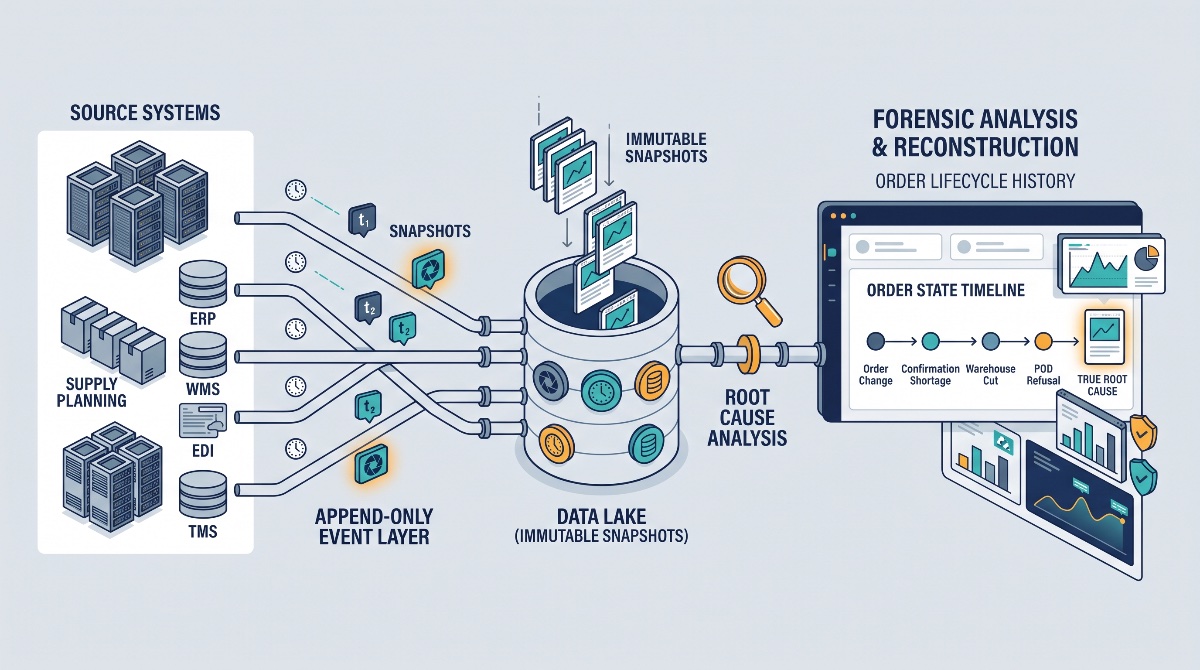
You replace static reason-code reporting with Bitemporal Decision-Point Snapshots in your Cloud Data Warehouse (such as Snowflake).
In a live supply chain, planning and execution tables are constantly overwritten. If an order is cut on Tuesday morning because a DC projected a 540-unit deficit, the very act of cutting that order removes 540 units of demand from the weekly bucket. By Tuesday afternoon, the live planning screen shows healthy, positive inventory. Any analyst—or AI agent—looking at Wednesday’s screen will conclude there was plenty of stock and blame the warehouse.
To defeat hindsight bias, a bitemporal evidence layer archives append-only snapshots across Commercial, Demand,Supply Planning, Manufacturing, Procurement, and Inventory at each function’s last actionable decision fence, recording two distinct timestamps for every row:
-
Valid Time: The business week or operational moment the projection applies to.
-
Load Time: The exact timestamp when that snapshot was published and visible to the planner or batch job.
5. How to Transition From Attribution to Protection
Moving from retrospective reason-code policing to a bitemporal evidence layer doesn’t require ripping out your ERP or rebuilding your existing CFR dashboard. You extend your current reporting lineage with three pragmatic steps:
-
Preserve the Atomic Event Chain: Stop overwriting a single reason-code column. Log every confirmation change, BOP reduction, rejection code, and delivery closure as an immutable, timestamped event in your cloud data warehouse—including a derived reason code for “silent” cuts closed by customer delivery tolerances.
-
Capture the Initial Confirmation at Order Entry: Knowing whether an order was Never Confirmed versus Confirmed Then Lost (e.g.,
128 → 38) is the single most important branching signal in fulfillment diagnostics.The first points directly to master data, product lifecycle, or sourcing misalignment; the second points to network deployment, factory attainment, or BOP reprioritization. -
Start Archiving Daily Planning Snapshots Now: You cannot reconstruct overwritten history retroactively. Begin landing daily, append-only snapshots of your Advanced Planning System (APS) supply/demand views, order change documents (e.g., SAP
CDHDR/CDPOS), and material status tables with explicit load timestamps today.
Once your data layer remembers what each system knew while it still had time to act, CFR stops being a backward-looking blame report. It becomes the radar for an automated protection engine.
What’s Next in This Series
In CFR 2: Rescue Open Orders Fast: The Two-Speed Case Fill Rate Loop, we show how to put these bitemporal snapshots to work—connecting a Fast Loop (that rescues at-risk orders hours or days before Goods Issue) with a Slow Loop (that automatically turns recurring cut patterns into governed master-data fixes so the same failure never happens twice).