Every day, I am more amazed by how AI has simplified the creation and structuring of articles. But words aren’t worth your time if they are just the product of automatic, robotic generation. This piece brings both sides together: the analytical power of AI, combined with my own years of hard-won experience in the supply chain technology trenches. Here is how we can use this technology not just to write about problems, but to solve them.
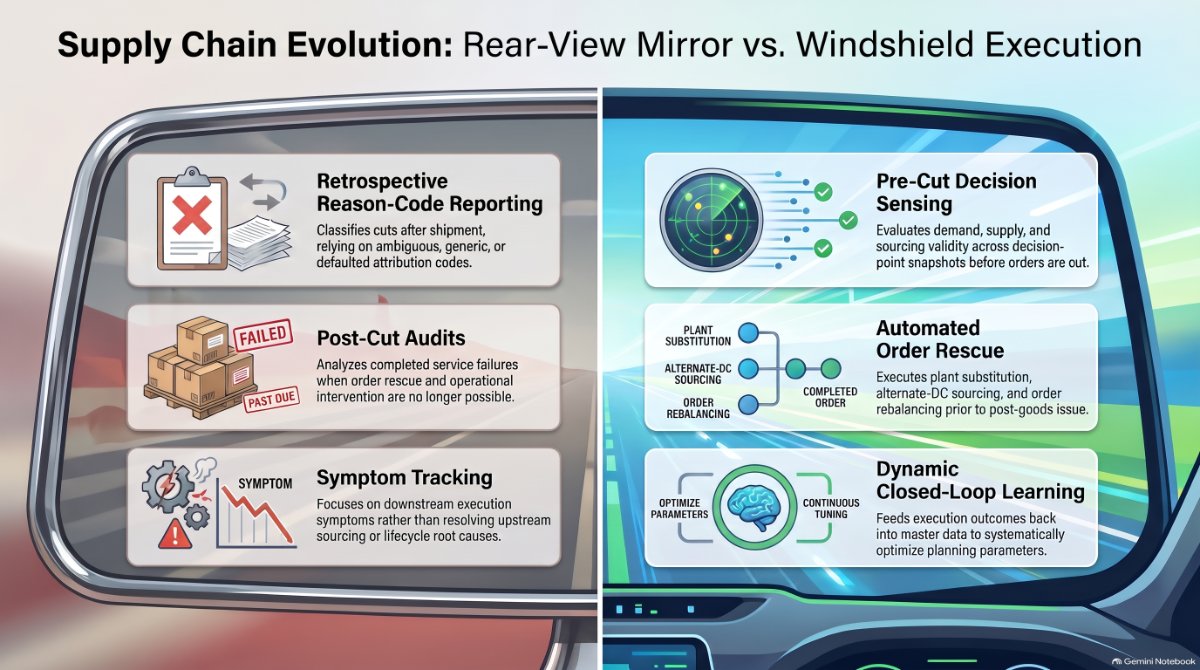
You cannot steer a supply chain by staring into the rear-view mirror.
Yet most Case Fill Rate (CFR) operations do exactly that: wait for an order to fail at Post Goods Issue (PGI), stamp an ambiguous reason code on the post-mortem report, and debate the casualties in next month’s cross-functional review.
In article ‘Stop Blaming Demand Planning for Stockouts‘ we discussed why forcing a single retrospective reason code onto an order cut distorts reality and leads to misallocated capital.
Fixing that scoreboard is essential, but retrospective analysis only looks backward. The real competitive leap is shifting your gaze to the windshield—pairing root-cause diagnostics with a forward-looking operational radar.
By deploying a Two-Speed CFR Protection Loop that pairs read-only AI diagnostic agents with human-in-the-loop decision rights, is possible to detect order exposure days before dispatch, rescue at-risk cases before the truck leaves, and feed those outcomes back to permanently repair the master data that created the risk.
The Forensic Lens: Reconstructing What Systems Actually Knew
What happens when you stop trusting recorded reason codes and reconstruct what planning, inventory, and order-management systems knew the exact moment an order arrived?
Placing typical order cuts under the microscope via historical snapshots in a centralized data lake reveals that what looks like standard fill-rate casualties are actually three distinct, preventable operational breakdowns:
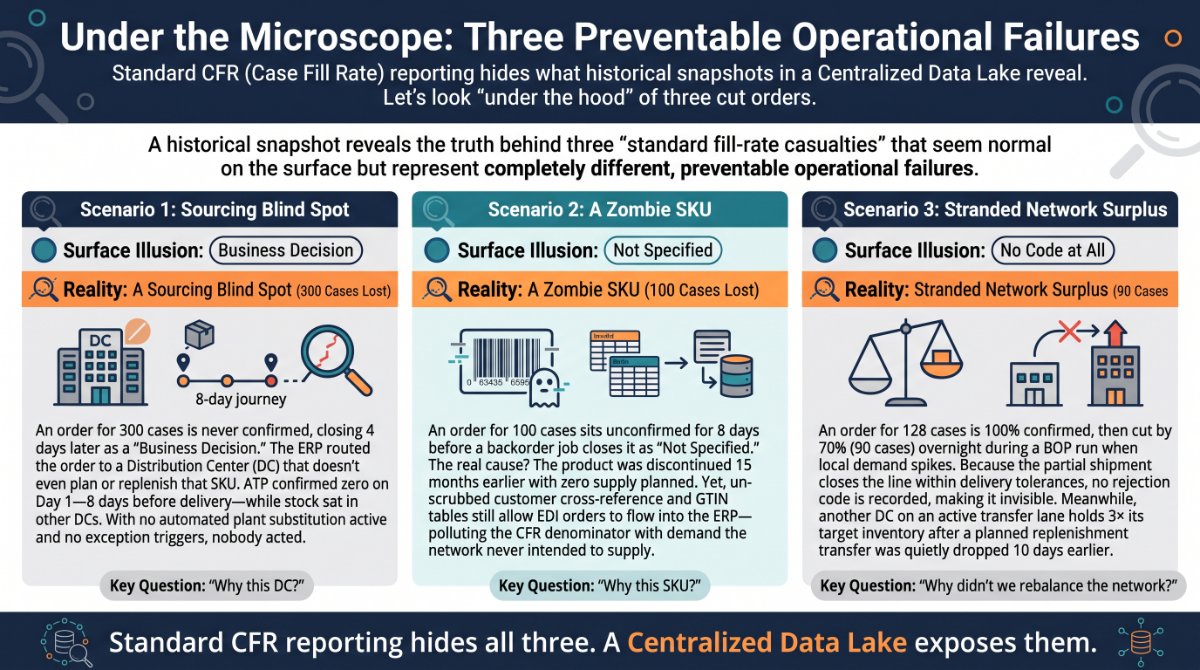
Scenario 1: Sourcing Blind Spot (300 Cases Lost)
-
Reported Code: “Business Decision”
-
Operational Reality: The ERP routed an order to a Distribution Center (DC) that does not stock or replenish that SKU. Available-to-Promise (ATP) confirmed zero units on Day 1—eight days before the required delivery date—while surplus inventory sat in neighboring DCs. Because automated plant substitution was inactive and zero-ATP confirmations generated no alert, nobody took action.
Scenario 2: The “Zombie SKU” (100 Cases Lost)
-
Reported Code: “Not Specified”
-
Operational Reality: An order sat unconfirmed for eight days before an automated backorder batch closed it. The product had been discontinued 15 months earlier with zero planned supply network-wide. Yet unscrubbed customer cross-reference and GTIN mapping tables allowed EDI orders to enter the ERP as executable demand, artificially penalizing CFR for orders the business never intended to fulfill.
Scenario 3: Stranded Network Surplus (90 Cases Lost)
-
Reported Code: None (Unrecorded)
-
Operational Reality: An order for 128 cases was confirmed at entry, then cut by 70% (90 cases) during an overnight Backorder Processing (BOP) run when local demand spiked. Because partial shipments fell within customer delivery tolerances, no rejection code was triggered—making the 90-case loss completely invisible on standard reports. Meanwhile, an adjacent DC on an active transfer lane was holding 3× its target inventory after a planned stock transfer had silently dropped ten days prior.
The Solution: A Two-Speed, Human-in-the-Loop Architecture
You do not need a multi-year ERP overhaul to fix this. In most enterprises, the operational levers already exist—they simply lack real-time connection to decision-point evidence.
By capturing daily, append-only snapshots from Order Management, Planning, Manufacturing, Procurement and Inventory into a centralized data lake, organizations can establish a dual-tempo defense:
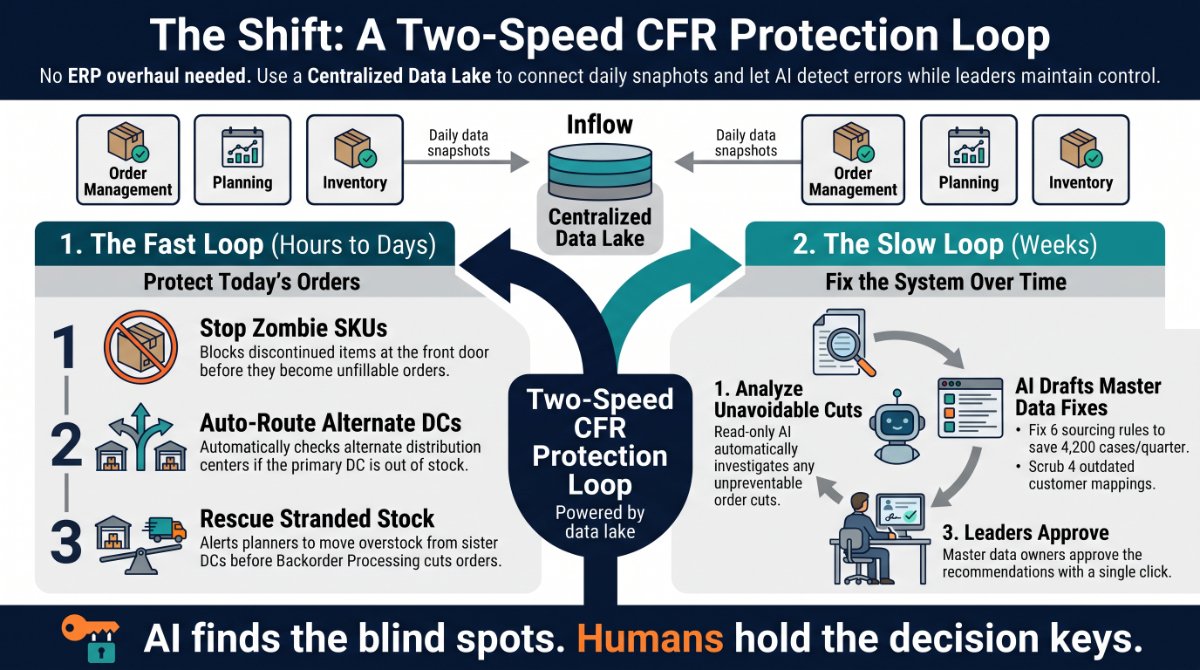
1. The Fast Loop: Protect Today’s Shipments (Hours to Days)
Rather than waiting for order closure, automated rules scan open order books across rolling operational horizons:
-
At Order Ingestion: Intercept and reject “Zombie SKUs” before they register as unfulfillable demand.
-
At Confirmation: Automatically trigger Alternative-Based Confirmation (ABC) rules across authorized secondary nodes when the primary DC is constrained.
-
Prior to Backorder Runs: Flag projected stockouts to planners when sister DCs carry excess safety stock, surfacing pre-calculated rebalancing or transfer orders days before automated BOP cuts customer allocations.
2. The Slow Loop: Cure Systemic Defects (Weeks)
Unpreventable cuts trigger an automated diagnostic sequence executed by read-only AI agents operating over governed data models. Instead of assigning a blunt category, the agent traces the earliest point of controllable failure and drafts concrete parameter updates for master-data custodians:
-
“Detected 14 cuts across 90 days tied to this material–DC pairing. Recommend updating source determination rules for these 6 SKUs. Estimated CFR protection: 4,200 cases/quarter.”
-
“SKU-2002 is phased out with zero network inventory, yet 4 active customer EDI cross-references remain open. Action required: Execute catalog discontinuation protocol.”
Why this can be built now.
The most encouraging takeaway from this architecture is how rapidly it can be deployed without operational risk:
Zero ERP disruption to start:
You don’t touch live order processing to begin. Archiving daily planning and order snapshots in your data lake and running forward risk-detection rules requires zero changes to your core ERP.
AI does the legwork; humans approve the action:
By giving AI diagnostic agents read-only access to curated data lake views via Model Context Protocol (MCP), planners no longer need to spend hours digging through disparate order change logs, inventory movements, and weekly supply buckets. The diagnostic agent surfaces the evidence chain, and an orchestrator agent ranks the rescue options based on feasibility and cost. Planners and data owners simply review, confirm, and execute.
You unlock controls you already own:
Often, the highest-ROI fix isn’t new software—it’s turning on automated plant substitution for key lanes, enforcing a lifecycle gate at order entry for discontinued SKUs, or keeping cut lines open for 48 hours so Customer Service has a window to rescue them.
The executive scoreboard becomes forward-looking:
Instead of just reviewing lagging CFR, leadership tracks Cases Saved Before PGI, Time from First Signal to Action, Master-Data Fixes Deployed, and Repeat-Cause Recurrence.
A zero confirmation or an impending backorder cut isn’t the end of the story—it’s an early warning signal that arrives 8 to 30 days before the customer feels the pain.
Every order cut should produce one of two outcomes: either you rescue the cases before the truck leaves, or you fix the master data so the same cut never happens again.