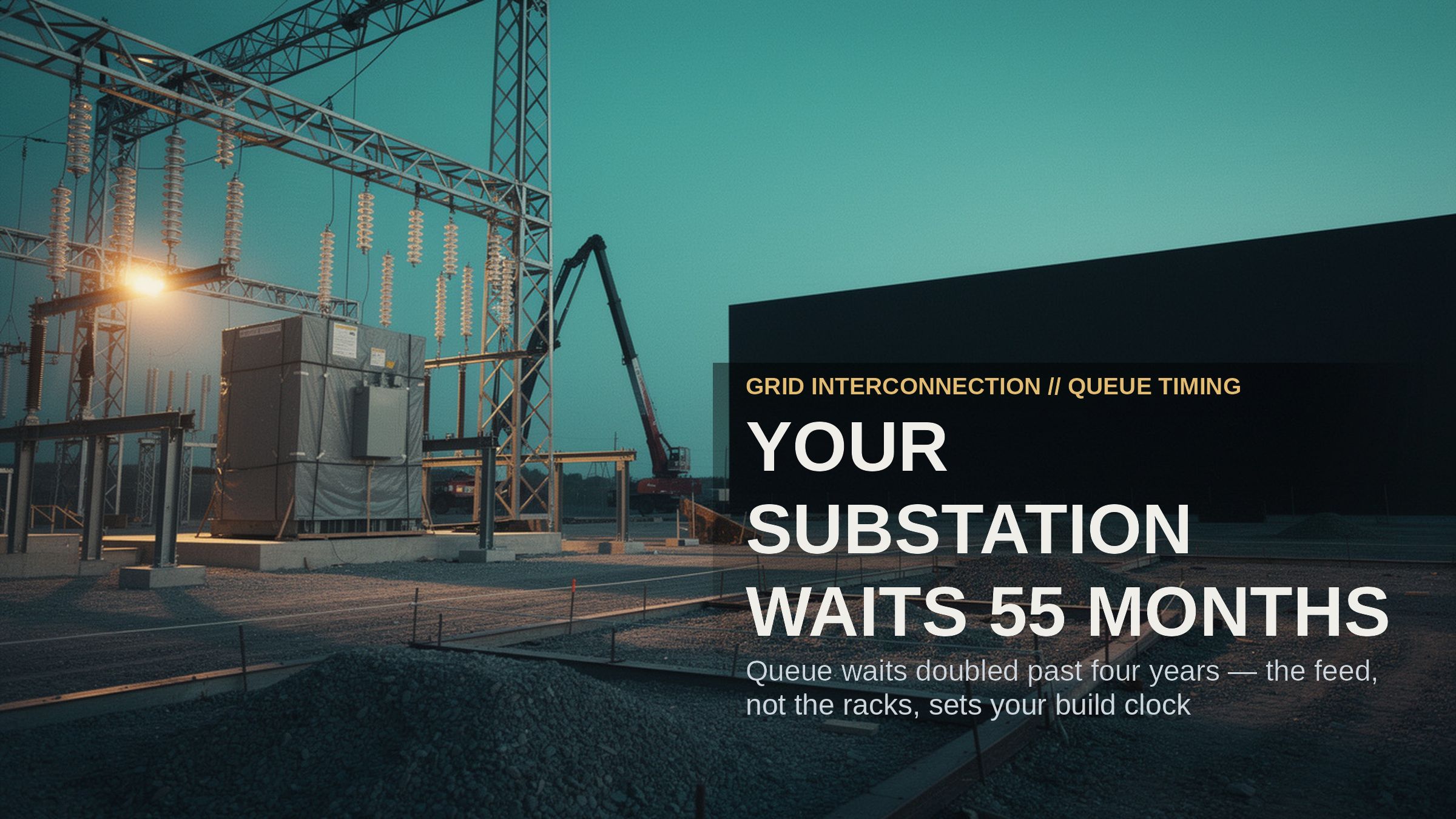
Your Substation Waits 55 Months
The clock on your next build is not the chip roadmap. It is the grid queue. Its median wait has doubled: under two years once, over four now [1]. A feed bigger than 200 megawatts took 55 months to go live [3]. The plan always assumed the power call would be settled years before the racks were ordered. It rarely is, and the queue’s own arithmetic is why.
At a glance
The wait between asking a utility for a power feed and getting one now outlasts the build it serves, and anyone planning a data hall or a plant build is exposed. Drop-outs — not approvals — set the odds you plan against.
The queue quietly became the build schedule
The wait grew in steps, and each step resets what a build plan may assume. Projects that entered the queues before 2008 went live in under two years. Projects built in 2015 took about three. Projects reaching service in 2023 took about five [3]. The 2025 federal report on the queues puts the median for 2018–2024 builds at over four years [1]. Behind that climb sits a structural problem, not a staffing one. Of all the power that applied from 2000 to 2019, 77% had dropped out by the end of 2024 and only 13% went live [1]. An application costs little next to the value of holding a place in line, so developers apply early and often, and every serious request waits behind a crowd of hedged ones.
I read the two reports back to back before the pattern was plain to me: the queue is not slow because utilities are lazy. It is slow because it is full of requests nobody expects to survive.
By the numbers
- 77% dropped out: The share of power that applied from 2000–2019 and never went live [1].
- 55 months to live: The median span for feeds over 200 megawatts, against 4-plus years past 100 [3].
- 544-day study: One regional grid operator’s completed cluster study, filed against a 540-day limit [2].
Where this bites
The cost lands on sequencing. The largest US regional grid operator now takes about eight years to bring a new plant online, while it runs its own power auctions on a two-to-three-year horizon [2]. A team that orders servers first and asks for the feed second has scheduled the wait after the spend — the worst ordering available. What the teams closest to the queue have chosen to do, from what I can see in their filings and their study calendars, is apply earlier than feels right, treat the deposit as money spent buying an option with known drop-out odds, and pair the queue entry with power made on site, so the site can run while the feed matures. That bridge has its own rules to clear — see The 40 kW Line: Why the AI Rack Is a Building Project for why the cooling and feed work is a dated build in its own right. The signal that answers the open question for your region is the grid operator’s own study calendar, not a vendor’s ship date.
The catch
The hard part, said plainly: no reform fixes your five-year wait. Federal queue reforms are in place, but that same 2025 federal report finds it too early to measure their effect [1]. The first completed cluster study after the reform at that grid operator still ran 544 days against a 540-day allowance [2] — a reform meeting its target is not a queue that clears. My reading, held loosely: if your load truly needs the grid, the honest math treats your request as one of the 77% until it is not, and keeps the on-site bridge funded and permitted. The call was never “substation or no substation.” It is whether you can afford to be wrong twice — once waiting for the feed, once waiting for the bridge.
Related reading
- Agentic AI Adoption Soars, But Profits Stall in 2026
- Enclave overhead: 62.8%, not 4%
- Multi Agent Orchestration
Sources
- [1] Lawrence Berkeley National Laboratory, “Queued Up: 2025 Edition” (abstract) — https://www.osti.gov/biblio/3008763
- [2] RMI, “PJM’s Speed to Power Problem and How to Fix It” — http://rmi.org/resources/pjms-speed-to-power-problem-and-how-to-fix-it
- [3] LatitudeMedia, “The US interconnection queue is twice its installed capacity” — https://www.latitudemedia.com/news/the-us-interconnection-queue-is-twice-its-installed-capacity