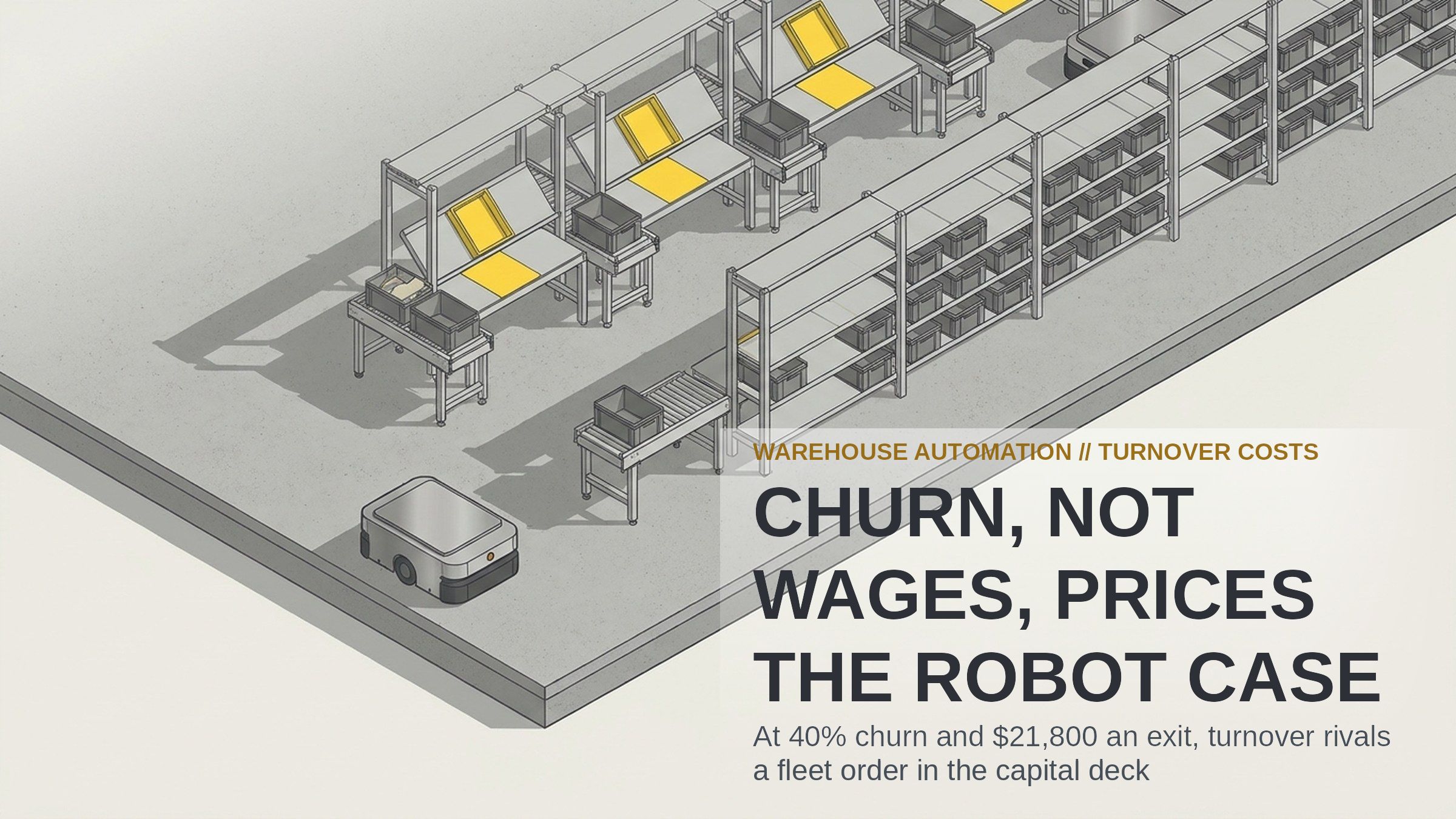
Your labor line churns about 40% a year, and every exit bills the business. That rate is the 2026 estimate from the Bureau of Labor Statistics’ Job Openings and Labor Turnover Survey (JOLTS) for transportation and warehousing [1]. Gallup’s standing replacement rule charges 40% of a worker’s pay to refill one seat, which in warehousing works out to about $21,800 an exit [2]. At a 200-person distribution center, that churn refills about 80 seats a year. A robot fleet has to beat this stream, not the wage bill.
At a glance
This article is for supply chain leaders weighing a robot fleet against a retention program. It argues that warehouse labor turns over about 40% a year, each exit costs a four-figure price, and the labor line in an automation payback should be priced from replacement cost.
The Floor Empties Every Year
The wage line looks calm, and the churn hides behind it. Warehousing paid an average of $26.76 an hour in April 2026, about $54,500 a year [2]. The same federal data family also counts separations, and the 2026 series reads roughly 40% a year [1]. A budget built on wages alone sees a stable floor and misses the refill running under it.
Refilling a seat costs more than the wage printed on it. Hiring and screening alone run $800 to $1,500 per hire [1]. A new associate works at 60–70% of standard in the first month, while trainers stop picking to train [1]. Overtime covers the open seat at time-and-a-half. CognitOps prices a full warehouse exit at 50–150% of yearly pay once all of that is counted [1]. Its own example is blunt: a mid-size DC with 200 people and 40% churn absorbs $1.5 million a year or more [1]. I read that figure twice before believing it, because it means churn alone can rival a fleet order in the capital conversation. The fleet is budgeted against the wage. The leakage sits in the churn above it.
By the numbers
- $21,800 per exit: Gallup’s 40%-of-salary replacement rule applied to warehousing’s $54,500 annual average [2].
- $1.5 million a year: replacement costs at a mid-size DC running 40% turnover on 200 people [1].
- 60–70% of standard: what a new associate produces in the first month, while trainers stop picking [1].
How Operators Model the Line
The teams closest to this math split the exits by type before they spend anything. A seasonal spike that heals itself and a quit problem that compounds call for different levers [2]. Then they price both levers on the same line item. A retention program — career paths, better schedules, small role-based bonuses — costs $2,000 to $5,000 per associate a year [1]. One exit costs several times that. On a 200-person floor, that program and a robot fleet chase the same operating budget, and only one of them sits in the capital deck.
My reading is that the case should carry the wage and the exit cost together, the way this desk’s wage-floor payback argument already carries the wage 3. That earlier piece prices the federal median for the occupation the picking floor is staffed from — the hand-mover job the O*NET wage table puts at $19.35 an hour [4]. A case priced at the wage alone undercounts the line by the churn stacked on top of it. What I am watching next is whether operators start publishing the loaded labor rate at all, because the payback math divides by it either way.
The Catch
The two published exit-cost rules disagree, and they sit on different bases. Gallup’s rule charges 40% of pay at warehousing’s average earnings [2]. A Center for American Progress estimate charges about 20% of pay for a worker earning under $50,000 [1]. One share rides an industry average; the other rides a lower wage band. The spread is honest, and no single number is the exit cost.
What I find hard to square is how much of that churn a modest retention budget could hold. A retention program makes a smaller claim than a robot pitch does. It does not delete the labor line a fleet targets; it steadies the churn running through it. The net cost of the labor line is the real baseline for the payback math. Price both levers against that baseline, and buy whichever moves it for less.
Related reading
- 71% Margin Is Your Exit Bill — more on Supply Chain & Operations
- Your $1,100 Tool Bills Every Unit — more on Supply Chain & Operations
- CaseProof: Stop Signing $3M Warehouse Automation Deals on a… — more on Business Automation & Operations
Sources
- [1] CognitOps, “The Real Cost of Warehouse Employee Turnover” — https://cognitops.com/warehouse-employee-turnover-costs
- [2] Fountain, “Warehouse turnover rate: how to calculate and reduce it” — https://www.fountain.com/posts/warehouse-turnover-rate
- [3] Editorial-Factory, “Warehouse Payback: $17.00, Not $17.95” — https://aichieve.net/wage-floor-sets-robot-payback/
- [4] O*NET OnLine, “Summary Report for 53-7062.00 — Laborers and Freight, Stock, and Material Movers, Hand” — https://www.onetonline.org/link/summary/53-7062.00