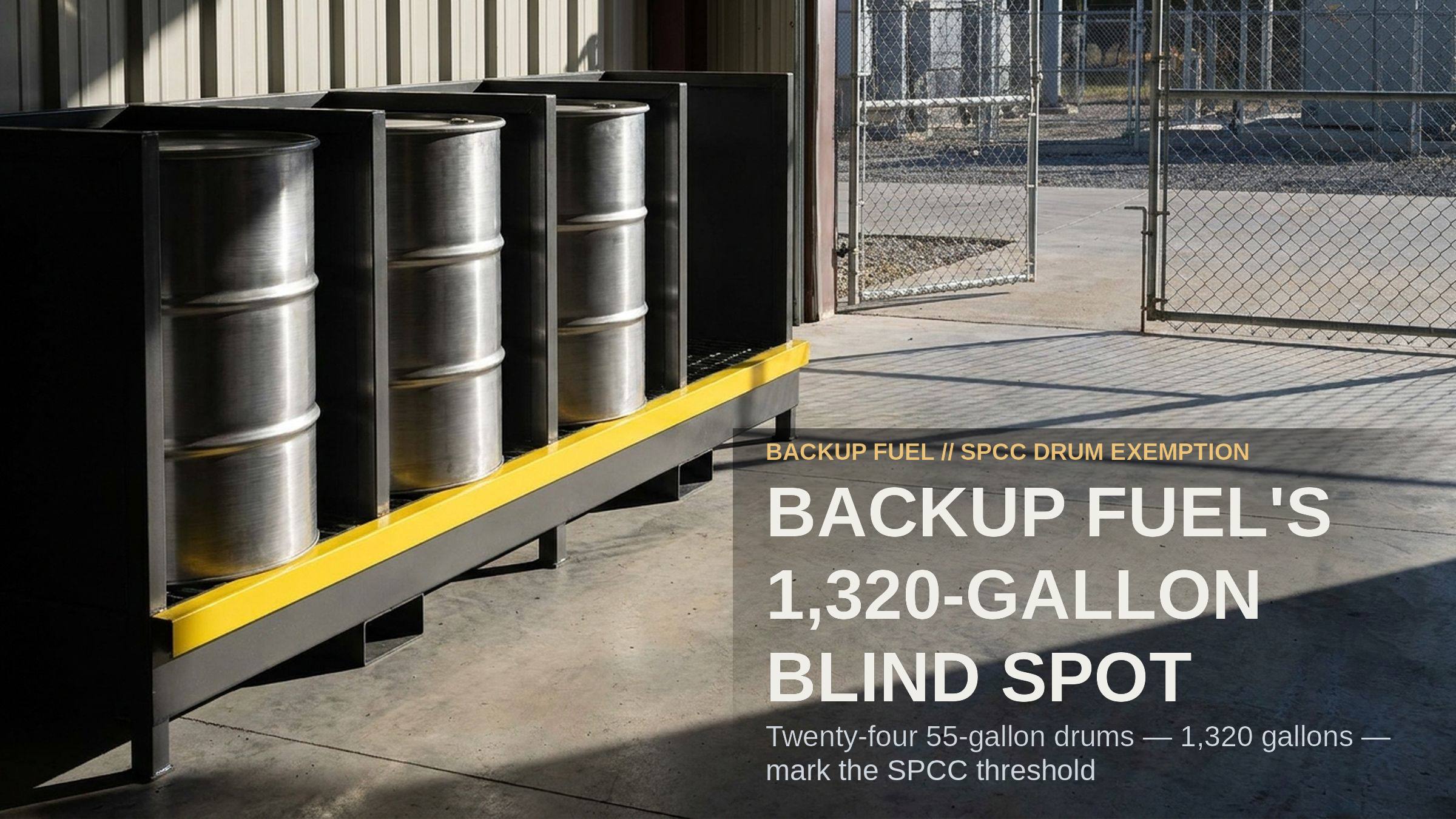
Your backup fuel has a blind spot, and it is the drums. Twenty-four 55-gallon drums come to 1,320 gallons, the exact ceiling of the federal spill exemption; above that, a site that could plausibly leak oil into a river or lake needs a Spill Prevention, Control and Countermeasure (SPCC) plan [1]. The total grows without anyone ordering a bigger generator, driven by halls that now store fuel for a three-day outage rather than a few hours. That is the part operators miss. The count runs by container.
At a glance
- The shift: Backup fuel, not the generator, is the regulated asset on a behind-the-meter site.
- The number: 10,000 gallons of aboveground fuel ends the self-certified plan [2].
- The risk: One container above 5,000 gallons needs a licensed engineer’s sign-off [3].
Old rule, new fuel estate
The Environmental Protection Agency (EPA) wrote this rule in 1973, and the section page still prints the 2002 rewrite and the December 2006 amendments [1]. What changed is the estate, not the statute: a hall that once kept a small day tank now holds fuel for a long outage, and every container of that size or larger joins one total [1]. A site that counts the big tank and forgets the drums is running a number nobody wrote down. I have been reading the exemption all week, and the unit it counts is not the unit the power plan is written in.
Some tanks that look buried still sit on the aboveground side. A bunkered tank, cut into the ground and covered again, is one. A partly buried tank is another, and so is a tank inside a vault. Only a tank wholly below grade and covered with earth, sand or gravel counts as completely buried [4].
That is where quiet errors start. A tank sunk into gravel to keep the loading apron clear still counts as aboveground, so a tidy yard can make a small plant a regulated facility. The nameplate on the generator never enters the count, which took me three passes through the definition to accept.
Between the exemption and the signature sits a rung most sites never price. A Tier I qualified facility holds no single aboveground container above 5,000 gallons, and it may sign off on its own plan. A Tier II facility may hold a larger container, if its total stays at or under 10,000 gallons and its spill record is clean: no single spill over 1,000 gallons, and no two over 42 gallons in any twelve-month period of the last three years [3]. Cross either line, and a licensed Professional Engineer must review and sign that plan [3]. Membership of the cheap tiers depends on a tank size the site is about to choose.
By the numbers
- 5,000 gallons in one container: the largest single aboveground tank a Tier I site may hold [3].
- Five years: how often the plan must be reviewed, with any change drafted inside six months [5].
- 110 gallons: the underground-tank size at or below which a buried tank leaves that program [6].
Where this bites
Bury the tank to clear the yard, and the site does not escape. It moves into the underground-tank program, a separate set of duties that starts at a size floor of 110 gallons [6]. That program also leaves out a tank that holds heating oil for consumptive use on the premises, which it defines as oil burned where it is stored [7]. Generator fuel sits close to that wording. I would want a written answer from the agency before designing around it, because the exclusion reads on what the oil is for, not on what it feeds.
The paperwork after a small expansion worries me more than the expansion itself. Two more drums and a bunkered tank change the total without touching the generator schedule, and no handover checklist asks for the new figure. The review every five years is the only scheduled point where that gap shows up [5], so it is the part of the plan most likely to describe a building that no longer exists.
The catch
The spill rules do not reach every site. They cover facilities that could plausibly leak oil into navigable water, so a hall far inland may sit outside them [1]. Whether a site is covered depends on the ground under the plant, not on the industry it serves. The count also rewards an honest inventory. A site that buries its fuel trades a containment duty for a different program, not for none.
Where I’ve landed: the cheap choice is the one that changes which rulebook applies. A bigger tank or one out of sight moves the site across a threshold, while the costly path, a signed plan and a review every five years, is at least a cost the site can see. The permit ladder a behind-the-meter plant climbs is the sibling problem on the emissions side, and both hinge on which asset the paperwork covers.
Related reading
Sources
- [1] U.S. Environmental Protection Agency, “40 CFR § 112.1 — General applicability,” Electronic Code of Federal Regulations, current as of 2026-11-17 — https://www.ecfr.gov/current/title-40/chapter-I/subchapter-D/part-112/section-112.1
- [2] U.S. Environmental Protection Agency, “40 CFR § 112.6 — Qualified Facilities Plan requirements,” Electronic Code of Federal Regulations, current as of 2026-11-17 — https://www.ecfr.gov/current/title-40/chapter-I/subchapter-D/part-112/section-112.6
- [3] U.S. Environmental Protection Agency, “40 CFR § 112.3 — Requirement to prepare and implement a Spill Prevention, Control, and Countermeasure Plan,” Cornell Legal Information Institute, retrieved 2026-11-17 — https://www.law.cornell.edu/cfr/text/40/112.3
- [4] U.S. Environmental Protection Agency, “40 CFR § 112.2 — Definitions,” Cornell Legal Information Institute, retrieved 2026-11-17 — https://www.law.cornell.edu/cfr/text/40/112.2
- [5] U.S. Environmental Protection Agency, “40 CFR § 112.5 — Amendment of Spill Prevention, Control, and Countermeasure Plan by owners or operators,” Electronic Code of Federal Regulations, current as of 2026-11-17 — https://www.ecfr.gov/current/title-40/chapter-I/subchapter-D/part-112/section-112.5
- [6] U.S. Environmental Protection Agency, “40 CFR § 280.10 — Applicability,” Cornell Legal Information Institute, retrieved 2026-11-17 — https://www.law.cornell.edu/cfr/text/40/280.10
- [7] U.S. Environmental Protection Agency, “40 CFR § 280.12 — Definitions,” Cornell Legal Information Institute, retrieved 2026-11-17 — https://www.law.cornell.edu/cfr/text/40/280.12