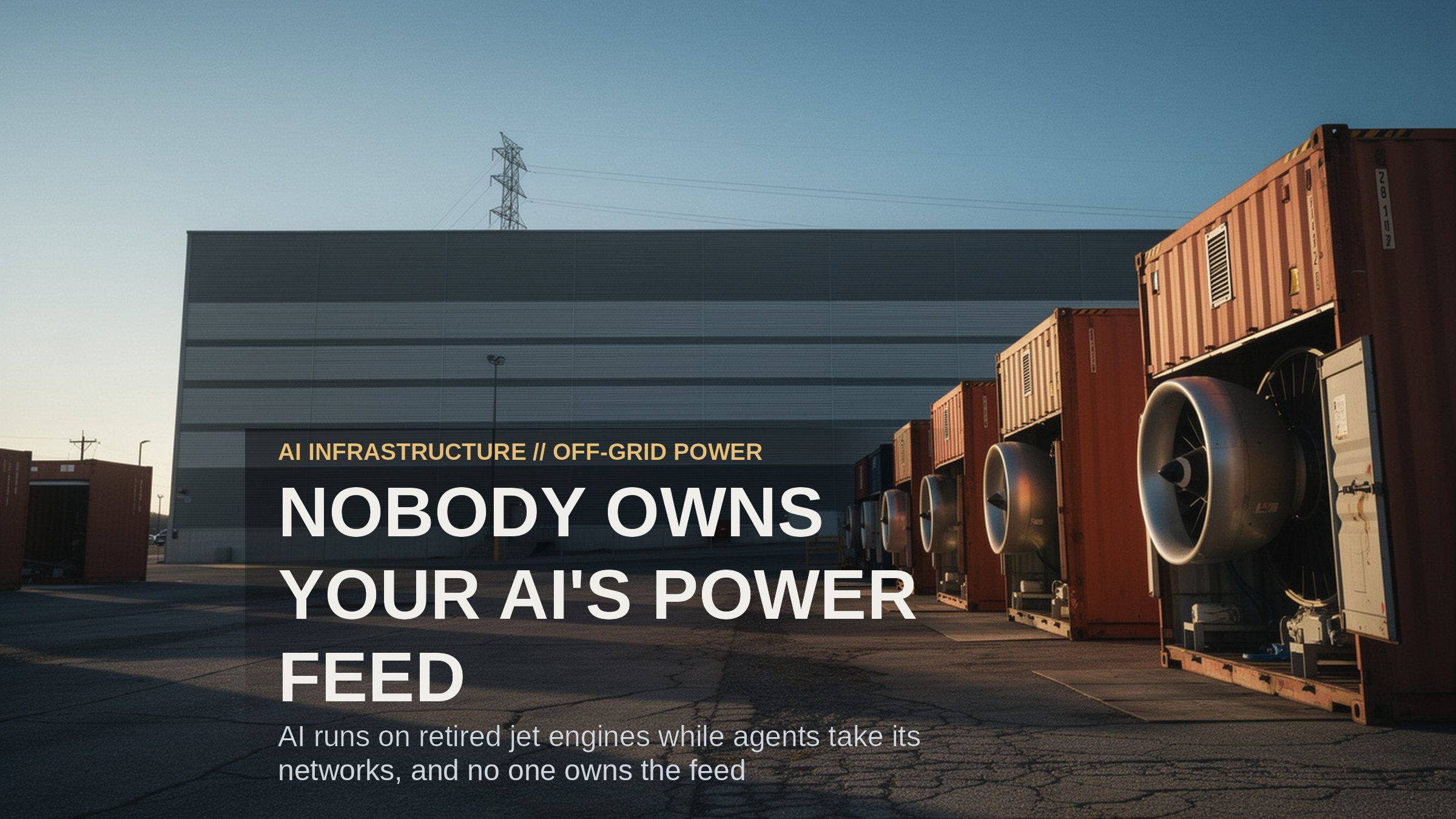
Eight retired jet engines now power xAI’s Mississippi data center, because the utility grid cannot deliver power to new sites fast enough [1]. 16 days later, a survey of 319 IT staff found that 72% of firms adapting their networks plan to hand control to agentic AI tools [2]. Those two facts are one story, and the seam between them is where the risk sits. The work and the control are moving onto local systems, and nobody owns the power feed underneath them.
At a glance
This article pairs two November 2026 events: xAI powering a Mississippi data center with eight scavenged jet engines, and a survey of 319 IT staff on edge AI readiness. It argues that the seam between improvised power and delegated control is the unowned risk for IT operations leaders.
Power and control leave together
The power side landed first. On 3 November, reporting showed xAI running eight turbine cores scavenged from old airliners at a Mississippi site [1]. ProEnergy, a Missouri firm that rebuilds unused General Electric jet cores from Boeing planes, did the work [1]. Each rebuilt jet produces up to 50 megawatts, roughly the load of 15,000 homes [1]. The state’s permits allow a 25% higher limit on volatile organic compounds than normal [1].
The Southern Environmental Law Center, a regional environmental law group, has already challenged that approval [1]. It alleges the projected emissions were undercounted, and formaldehyde sits among the chemicals in dispute [3]. I read the two facts as one and keep landing in the same place: the grid cannot light new AI sites fast enough, so the power gets makeshift from whatever burns.
The control side landed 16 days after that. Enterprise Management Associates released the survey on 19 November, paid for by Scale Computing, covering 319 IT professionals who work on edge inference strategy [2]. Only 40% of the people polled are fully sure their networks can support their edge AI plans [2].
Some 64% of firms split their AI work between edge sites and the cloud [2]. Just 18% avoid that split by running everything where the data lives [2]. The same report shows 72% of those changing their nets planning to adopt agentic tools, and 67% planning to fold in tools they already run [2]. The tools would steer networks the teams themselves do not fully trust. One caveat belongs in the same breath: a vendor paid for this research, and its fielding window is not disclosed, so the release date is the date to use.
By the numbers
- 8 converted jet engines: the turbines now running as xAI’s Mississippi power plant [1].
- 50 megawatts per engine: what one repurposed jet turbine produces, about 15,000 homes of load [1].
- 64% hybrid placement: enterprises splitting AI inference between edge sites and the cloud [2].
Where improvised supply meets delegated control
Put the two legs together and the seam shows. The edge sites now receiving AI work are, on the survey’s own numbers, sites whose networks only 40% of their teams fully trust [2]. The engines that could feed them face a live legal challenge [1]. Between those two facts sits a layer nobody in either report owns. The power contract, the network setup and the agent policy are being written by different hands, and I have not yet seen a document that joins them.
The people closest to the story are circling that gap. Scale Computing’s own pitch is to join compute, networking and security into one system, and its research found the split-up running of assets that gap creates [2]. In telecom, Nokia announced an agentic platform with Nvidia on 21 October [4]. It runs on the operator’s own site, so data, models and policies stay inside their walls. That is a launch announcement rather than a shipping product, but the demand it answers is real.
Researchers also released a closed-loop demo on 4 November [5]. In it, AI agents use reasoning, tool calls and test-run feedback to steer when wireless base stations wake and sleep [5]. That is the kind of control edge sites are being set up to hand over.
And the systems still fail the old way. On 11 November, a fault in one of its own data centers took Canonical’s launchpad and software download services down for about seven hours [6]. People spent half a day fixing it. What I am watching next is whether any on-site engine contract now ships with an agent veto clause — or whether the first report of an agent acting against a power cut writes that clause for everyone.
The catch
A vendor paid for this survey and has product to sell against the gap it finds. So the 72% figure deserves doubt, not dismissal [2]. The direction behind it is backed up by the separate scramble for power on the other leg [1]. And makeshift power is not automatically wrong. A jet core burning under a contested permit still burns. The other path is a site that never lights up at all.
Where I have landed is that the risk is not the engine and not the agent. The risk is the seam no one owns between them. Nobody has written the runbook that says which authority can cut which feed. Security teams already found this gap in agent bounds, where the kill switch misses half the agents in practice [7]. So the question I would put to any vendor selling both halves of this story — power and agents — is simple. Who holds the physical veto, and does that answer survive contact with the power contract?
Related reading
- Agentic AI Adoption Soars, But Profits Stall in 2026
- OpenAI’s custom chip beats Nvidia on power
- Right Locally, Wrong by 3.8 GW
Sources
- [1] Tom’s Hardware, “Elon Musk’s xAI installs eight converted jet engines to power Mississippi data center”, 2026-11-03 — https://www.tomshardware.com/tech-industry/data-centers/elon-musks-xai-installs-eight-converted-jet-engines-to-power-mississippi-data-center-permits-allow-25-percent-higher-limit-for-pollutants-concerns-raised-over-carbon-monoxide
- [2] PR Newswire / Scale Computing, “New Research Reveals Network Readiness Gap in Enterprise Edge AI”, 2026-11-19 — https://www.prnewswire.com/news-releases/new-research-reveals-network-readiness-gap-in-enterprise-edge-ai-302944747.html
- [3] The New York Times, “Old, Polluting Jet Engines Are Being Scavenged to Power Data Centers”, 2026-11-03 — https://www.nytimes.com/2026/11/03/climate/jet-engines-ai-data-center-generators-boneyard.html
- [4] Nokia newsroom, “Nokia advances AI-RAN toward commercial deployment… sovereign agentic AI platform”, 2026-10-21 — https://www.nokia.com/newsroom/nokia-advances-ai-ran-toward-commercial-deployment-and-physical-ai-launches-sovereign-agentic-ai-platform-for-telco-autonomy-with-nvidia
- [5] arXiv, “Agentic Wireless Optimization: Workflow Automation, Algorithm Design, and Multi-Timescale Network Operations”, 2026-11-04 — https://arxiv.org/abs/2611.05887v1
- [6] Ubuntu Discourse, “Service interruption affecting Canonical websites”, 2026-11-11 — https://discourse.ubuntu.com/t/service-interruption-affecting-canonical-websites/91653
- [7] giniloh.com / aichieve.net desk, “Kill Switch Misses Half Your Agents: 12 Vendors Agree” — https://aichieve.net/kill-switch-misses-half-your-agents/