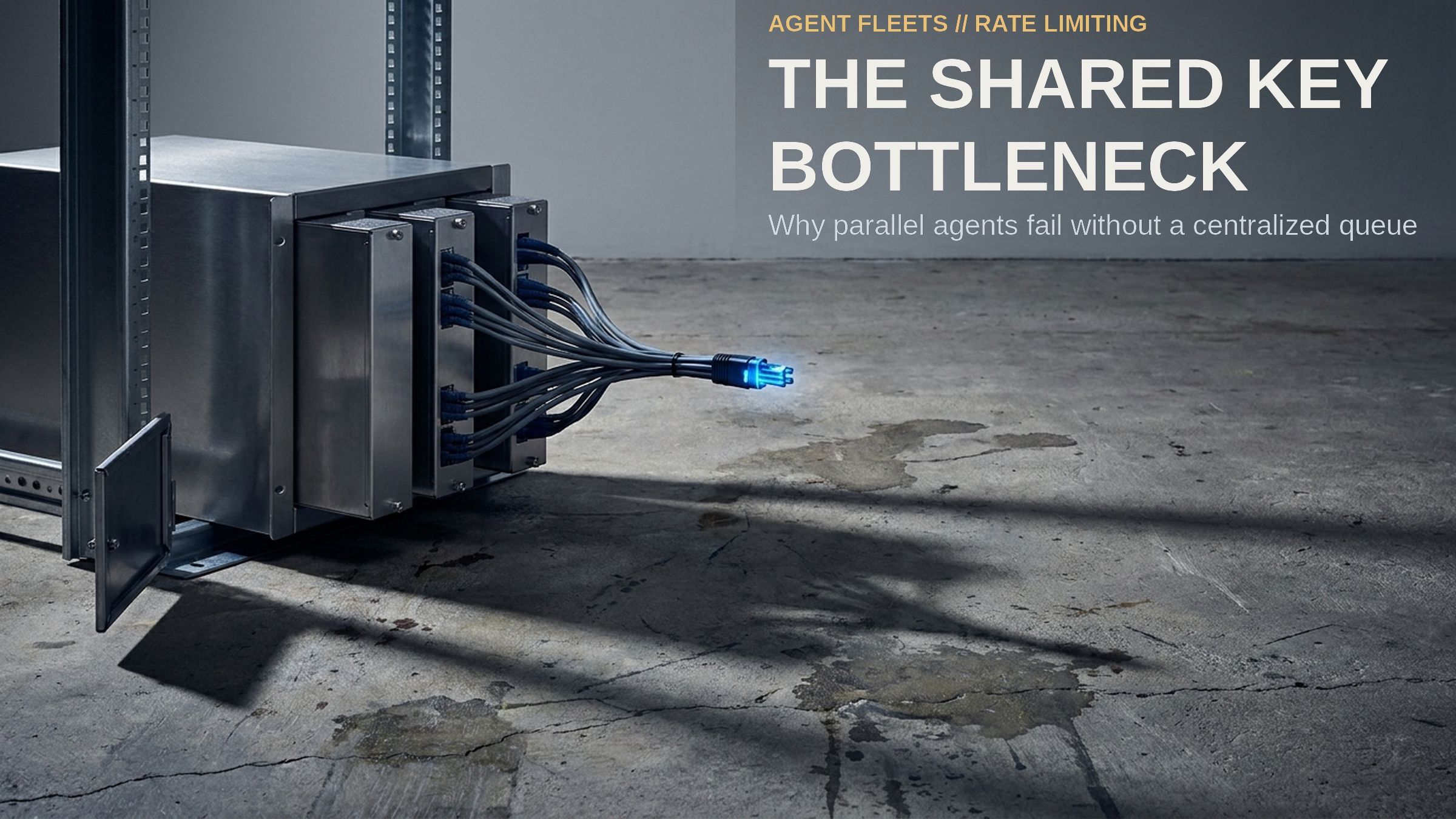
On 15 April 2026, eleven coding agents ran at once against one shared key, and three of them died before they finished. Two lost their connections, one got a bad gateway, and about 135,000 tokens went into runs that never ended [1]. None of the 11 agents was wrong: the calls were fine, the key was valid, and the vendor had enough spare capacity to serve all eleven one after another [1]. They failed because they were in each other’s way.
The big picture:
Most agent frameworks act as if capacity were endless, so each agent retries on its own schedule and nobody owns the pool they all draw on [1]. That holds at two parallel runs and breaks at twenty, because the real limit is how much work is in flight at once. Queueing theory gives this a name. Little’s Law states that the calls inside a system equal the arrival rate multiplied by the average time each call takes [2].
Once latency moves, the math turns fast. A server handling 100 messages a second at 100 milliseconds each holds about ten threads; let each call take ten seconds and the same traffic holds a thousand, enough to fill a thread pool [2]. Nothing in that sentence throws an error. Health checks stay green, the request rate looks normal, and the pool is full.
I read this as a blind spot in how we build fleets. Each run reports its own tokens, its own tool calls, and its own pass or fail. The one number that decides whether that run ends is how many other runs are calling at once, and no single agent holds it. A run stopped by a rate limit looks just like a run that hit a network blip, so every agent asks again.
By the numbers
- 72–100% — Unmanaged failure: across seven scenarios at 5 to 50 parallel agents, agents retrying on their own failed 72–100% of the time under load, while a shared gate cut failures to 0–18% and removed 48–100% of wasted compute [1].
- 81.8% — The cap alone: the test of each piece is the useful part. Limiting parallel runs with nothing else in place still failed 81.8% of the time, and dropping the shared retry left 63.6%, so a bare semaphore is not the fix [1].
- 1,000 threads — What a slow call costs: 100 messages a second at 100 milliseconds holds ten threads on average, and the same rate at ten seconds holds 1,000, which is Little’s Law in practice [2].
- 50 percent — The uptime cliff: when the median latency equals the client timeout, half of all requests are timing out, so a slow service turns into a down service [3].
What I’d watch:
The teams getting this right move the limit out of the agent and put it in front of the key. HiveMind, the open-source proxy behind those figures, sits between the agents and the vendor [1]. It admits work, tracks the vendor’s rate-limit state, pushes back when latency rises, caps each agent’s token spend, and keeps one retry queue. Agents keep their code, and the shared key gets one owner.
- Where the count lives: a per-cluster cap guards a pool but says nothing about who spent it. Envoy’s defaults make that plain, with circuit breakers on by default at 1,024 connections per cluster, counted per upstream rather than per caller [5]. A fleet that inherits those settings gets limits written for someone else’s traffic.
- Who retries: ten agents retrying a rate-limit error at the exact same moment is a stampede that trips the limit again, which is why the proxy runs retries through the gate [1]. Google pairs a cap of three tries per request with a retry share under 10% per client, because the per-request cap alone lets attempted load reach just under three times the original rate, while the share holds it near 1.1 times [4].
- What gets dropped: shed early. Reject excess work at the door and serve the newest requests first, so stale ones die instead of holding a slot [3].
- What I’m watching next: whether gateways ship a quota-aware mode by default, and whether vendors publish a per-key limit instead of leaving teams to find it through 429s. The proxy in that study added under 3 milliseconds per call, so the cost case against a gate is thin [1].
The fleet also has a meter nobody budgets, which pairs well with this one — the second meter in an agent fabric is where the harness spend hides.
The catch
The evidence points heavily toward a fleet-level gate, but it remains a single preprint: seven scenarios, one team’s own setup, self-reported figures, and a live check against two local model servers rather than a public vendor’s quota [1]. The direction matches decades of queueing practice, yet nobody has repeated the exact failure rates. The paper’s own test undercuts the tidy version of the story. Retry handling turned out to matter most, not just admission control, so a team that reads “cap the workers” and stops there lands on the 81.8% failure arm [1]. The gate works only when it holds the retry queue, the rate-limit state, and the in-flight count together.
My read is that the gate is a heavy lift. It takes far more work than a local semaphore, and it adds a shared point of failure unless the proxy is fully redundant. Fairness pays a price too. Serving newest-first keeps uptime high and starves the long job, making the shed rule a product decision rather than a simple toggle [3]. These limits date fast, so the lasting part is the math and the placement, not the numbers.
At a glance
- The Big Shift: Agent fleets are failing as queues rather than as errors. Eleven unmanaged agents on one key lost three runs and about 135,000 tokens on a day the vendor had room to spare, because the shared key was the bottleneck.
- Why It Matters: Each run reports on itself, so the number deciding whether it ends lives in nobody’s dashboard. That turns a capacity problem into a stream of retries, and retries spend the identical quota the fleet is already short of.
- What I’d Watch: Where the limit sits, and whether the service enforcing it can see every agent.
- One gate, one owner: A shared proxy that admits work, tracks the vendor’s rate-limit state, and runs retries in strict order.
- In-flight count: Arrival rate multiplied by latency, worked out from your own logs, is the parallel run count the pool requires.
- Shed rule: Which requests get refused first decides who pays for the overload.
- The Catch: The evidence is a single preprint with a promising but unrepeated result, the gate adds a hop and a shared point of failure, and its own test says retry handling matters more than the worker cap most teams would build first.
Related reading
- Your Agent Fleet’s 39x Gap — more on Autonomous & Agentic Workflows
- Agent Memory Poisoning — more on Autonomous & Agentic Workflows
- Long Context Is Not Memory — more on Autonomous & Agentic Workflows
Sources
[1] Agyemang, Kponyo, Somuah, Amponsah, Boakye, Agyekum. “HiveMind: OS-Inspired Scheduling for Concurrent LLM Agent Workloads.” arXiv:2604.17111v1, submitted 18 April 2026. https://arxiv.org/html/2604.17111v1 [2] AWS Builder Center. “Avoiding insurmountable queue backlogs.” https://aws.amazon.com/builders-library/avoiding-insurmountable-queue-backlogs/ [3] AWS Builder Center. “Using load shedding to avoid overload.” https://aws.amazon.com/builders-library/using-load-shedding-to-avoid-overload/ [4] Google. “Site Reliability Engineering,” chapter 21, Handling Overload. https://sre.google/sre-book/handling-overload/ [5] Envoy documentation. “Circuit breaking” (upstream architecture overview). https://www.envoyproxy.io/docs/envoy/latest/intro/arch_overview/upstream/circuit_breaking