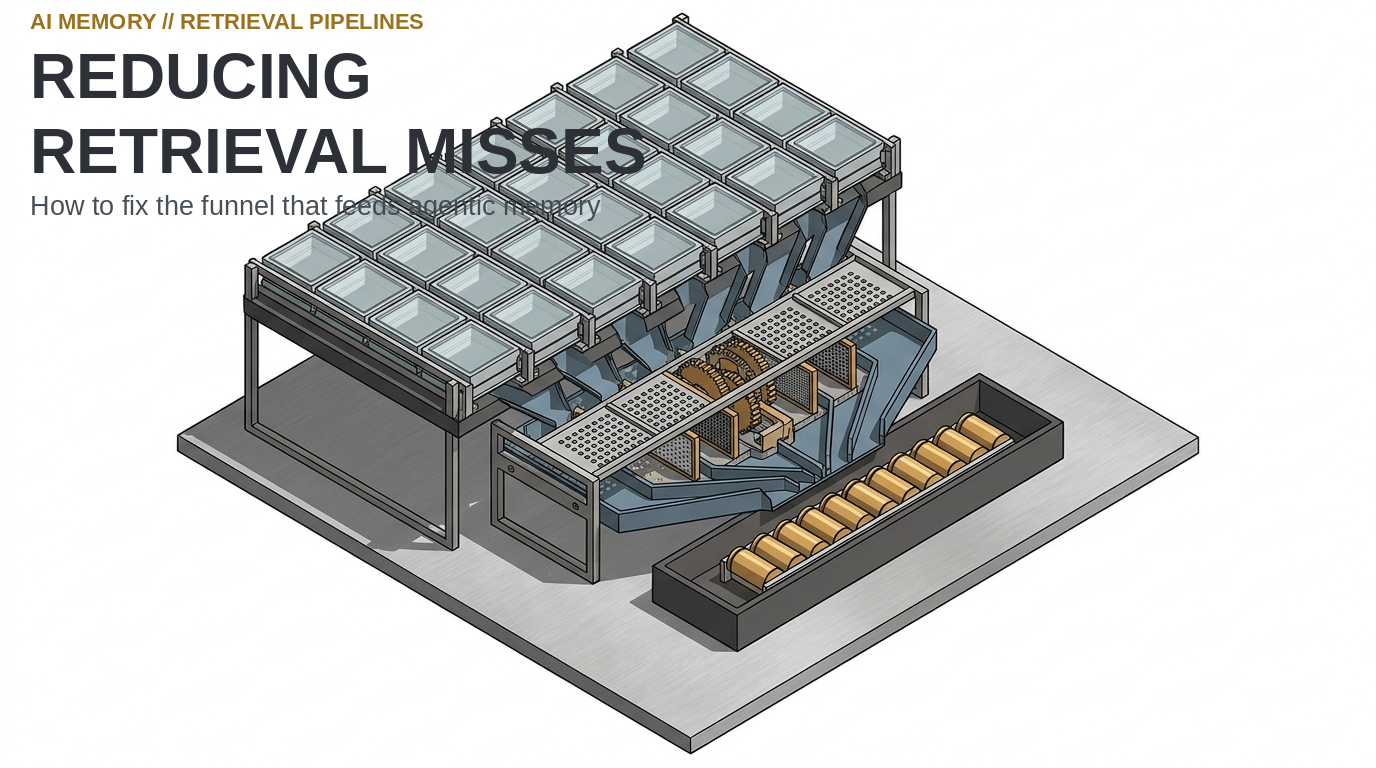
Anthropic’s retrieval test missed the right passage 5.7% of the time when it fetched the 20 best-matching chunks [1]. Each chunk then carried a line of context naming its source document. A second model ranked the results again, and the miss rate fell to 1.9%, a 67% cut [1].
The source text never changed. The questions never changed. Only the shape of the lookup did.
The big picture:
Most teams treat the memory tier as a database buy. The numbers that decide it sit inside the query.
The part I keep circling is how lopsided the levers are. The step that cut the miss rate hardest was not a new embedding model. It was a rerank pass: fetch 150 candidates, score them again, keep 20 [1].
The reason is plain. A short chunk carries its own words but not the document around it. Its embedding, a numeric fingerprint of meaning, cannot tell a quarterly total from an annual one [1].
Rewriting each chunk to name its source document fixes that before any search runs. It is a build-time job, paid once per chunk.
Anthropic’s own ladder is finer than one jump. Chunks with document context alone moved the miss rate from 5.7% to 3.7%, and a keyword index on top took it to 2.9% [1].
The rerank pass finished at 1.9%. That last rung repeats on every query, so it is the one with a running cost [1].
Chroma puts a number on the boundary itself. Recall moved by up to 9% across chunking strategies [2]. The 800-token size that Chroma calls OpenAI’s published default scored near the bottom of its table [2].
So there are three rungs: how the text is cut, how many candidates to fetch, and whether a second model reorders them.
By the numbers
- 5.7% to 1.9% — Miss rate drop: The top-20 failure rate on Anthropic’s test corpus, after chunks with context and a reranker [1].
- 150 to 20 — Candidates kept: That system pulls 150 candidates, reranks them, and passes 20 chunks into the prompt [1].
- 85.4% against 89.5% — Recall by size: Recall for 800-token chunks with 400-token overlap, against 400-token chunks with no overlap, on the same embedding model [2].
- 7.44% against 1.06% — Embedding model gain: The average score gain from a larger embedding model, against 1.06% for a smaller swap. Embedding quality often outweighed the chunking choice in the same study [3].
What I’d watch:
The people closest to this are spending their budget in a fixed order. It is not the order the tooling suggests.
- The vendor default loses: The 800-token chunk with 400 tokens of overlap scored 85.4% recall, below average in Chroma’s report [2]. The 400-token split with no overlap scored 89.5% [2].
- Reranking carries the finish: Reranked chunks with context reached 1.9%, against 2.9% without a rerank [1]. That gap costs one extra model call per query.
- Small corpora skip the funnel: Below 200,000 tokens, about 500 pages, the post advises putting the whole text in the prompt and skipping retrieval [1]. That threshold is the first thing I would want answered.
- Semantic chunking has to earn its place: A study of document, evidence and answer search found its gains depend on the data [3]. Fixed-size splitting often won on realistic documents [3].
The catch
My read is that the funnel is real but narrower than the framing suggests.
The headline ladder is vendor-reported. Anthropic ran its own benchmark on its own text, so 5.7% to 1.9% describes one knowledge base and one question set [1]. Chroma’s test is a token-level check on one embedding model and five retrieved chunks [2].
These studies measure search, not finished tasks. A passage that is found still has to be put to use. None of these numbers says how much a lower miss rate is worth at the end of the chain.
There is a counterweight worth tracking. In that study, embedding quality often outweighed the chunking decision [3]. That is why the model swap sits first in the order above, and the chunk boundary second.
The funnel also has a floor. Adding context to every chunk costs one model call per chunk to build. Reranking costs one per query at run time [1].
At a glance
- The Big Shift: An agent’s memory is queried through a funnel: chunk boundary, candidate count, rerank pass. That funnel moves the miss rate more than a like-for-like model swap [1][2][3].
- Why It Matters: A missed passage is an answer the model never gets to give. The fix is a query shape inside the runtime, not a new database.
- What I’d Watch: Where the funnel gets configured as teams build memory tiers.
- A 400-token split: Smaller chunks with no overlap beat the 800-token default on recall in Chroma’s table [2].
- A rerank step: A second model that reorders the top candidates, which carried the last leg from 2.9% to 1.9% [1].
- A 200,000-token floor: The corpus size under which retrieval is not worth running at all [1].
- The Catch: The headline ladder is vendor-reported on one corpus, and the studies score search rather than finished tasks. Extra context also adds cost at build time and at query time [1][2][3].
Related reading
- Your Multi-Agent Failure Has a Shape — more on Autonomous & Agentic Workflows
- 49.9% On Time: Shippers Stuck in the Gap — more on Supply Chain & Operations
- ParcelProof: Stop Bleeding 2–8% on Carrier Invoices — more on Business Automation & Operations
Sources
[1] Anthropic (Engineering). “Introducing Contextual Retrieval.” Published 19 September 2024, read 22 October 2026. https://www.anthropic.com/news/contextual-retrieval
[2] Smith, B. and Troynikov, A. “Evaluating Chunking Strategies for Retrieval.” Chroma Technical Report, 3 July 2024, read 22 October 2026. https://research.trychroma.com/evaluating-chunking
[3] Qu, R., Bao, F. and Tu, R. “Is Semantic Chunking Worth the Computational Cost?” arXiv:2410.13070v1, 2024, read 22 October 2026. https://arxiv.org/html/2410.13070v1