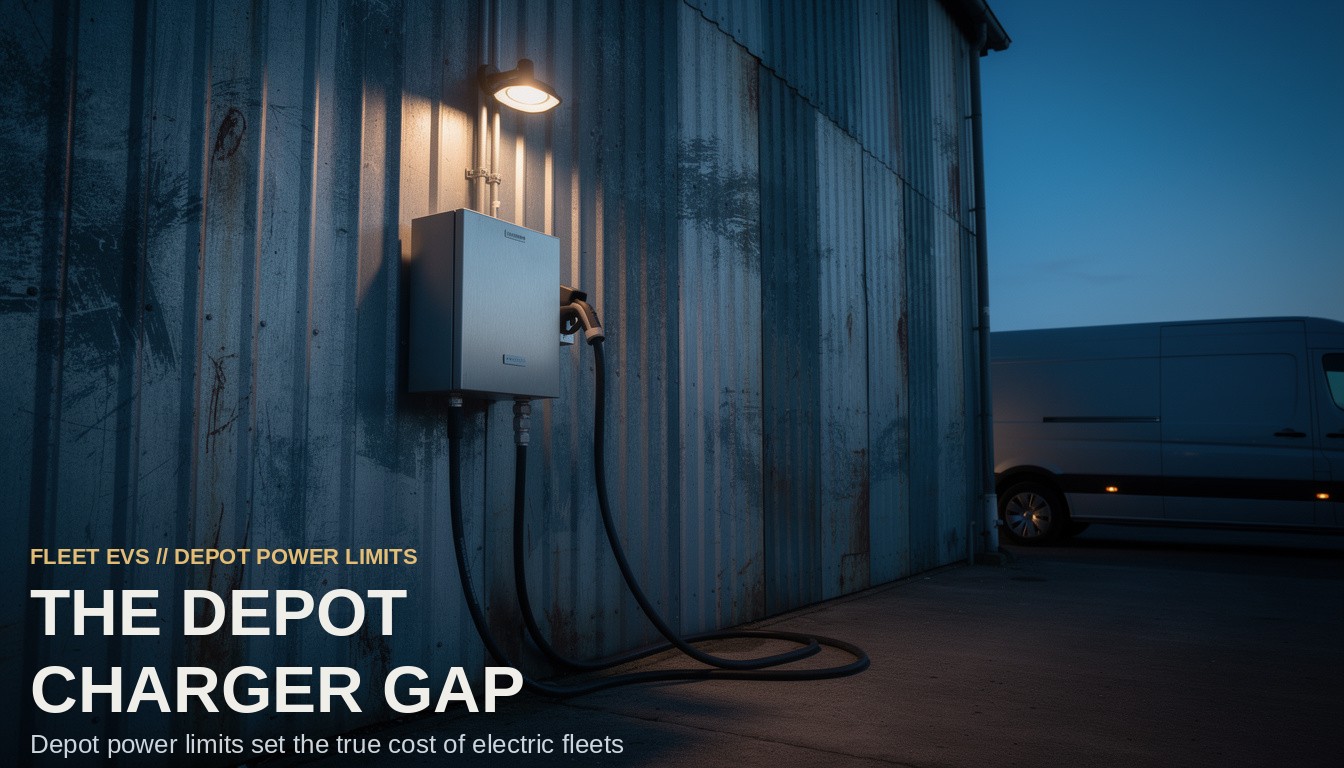
One Level 2 charging port puts out 7.2 kilowatts (kW) of power on its own dedicated 40-Amp circuit [1]. Plug a van in, and it gains about 25 miles of range for every hour it sits there [3]. That one line settles more of a fleet’s running cost than the van’s spec sheet does.
The big picture:
I keep reading the federal charging guidelines next to the power bills operators send me, and the same reality surfaces: the wall sets the bill, not the badge on the hood.
Chargers are not a single product. A Level 2 unit spans 2.9 to 19.2 kW, runs on 240 volts in a house but 208 volts in a business, and pulls 40 to 80 amps [2]. Each port demands its own 40-Amp circuit [1].
Going faster requires three-phase power. A 2018 standard for that method of charging (SAE J3068, the three-phase rule for plants and warehouses) covers 6 kW to 130 kW on the 208/120-volt and 480/277-volt feeds those sites already have [4].
Then there is the ceiling nobody puts in the sales quote. Fast chargers can deliver up to 500 kW, yet many electric vans on the road today cannot take a charge above 200 kW [5]. A bigger box cannot push past what the van will accept.
The metered kilowatt-hour (kWh) is the other half of the decision. U.S. retail power averaged 13.63 cents a kWh in 2025, with state averages running from 35.72 cents in Hawaii to 8.20 cents in North Dakota [6].
Less power gets into the battery than the meter charges for. About 84% to 93% of what the plug pulls arrives in the pack [7]. The van then turns 77% of that power into motion at the wheels, against about 12% to 30% for a gasoline van [7].
And the federal help is gone. The Alternative Fuel Infrastructure Tax Credit is listed as expired on June 30, 2026 [8]. Any plan still counting it as live money is out of date.
By the numbers
- 7.2 kW — Standard port output: The common Level 2 unit runs at up to 30 amps and requires its own dedicated 40-Amp circuit under the National Electric Code’s Article 625 [1].
- 13.63 cents — 2025 power price: The U.S. average retail price per kWh, with state averages from 35.72 cents in Hawaii to 8.20 cents in North Dakota [6].
- 84% to 93% — Charge efficiency: The share of metered power that reaches the battery, before the van turns 77% of it into motion at the wheels [7].
- Expired June 30, 2026 — The 30C credit: Businesses could claim 6% of qualifying costs up to $100,000 per item, or 30% if meeting federal wage rules, before the window closed [8][9].
What I’d watch:
The operators closest to this are not shopping for chargers first. They read a service panel and a rate schedule first, and my read is that this order sets the whole game.
- The circuit count: Each port needs its own 40-Amp circuit [1], so the existing panel caps the port count before fleets order any hardware. In one internal field note, a delivery company ordered 50 electric vans before asking the power company anything, then got a 26-month wait and $450,000 in transformer work to fast-charge them all at once [11].
- The charge window: Staggering the overnight charging schedule avoided both that transformer upgrade and the peak demand charge in the same case [11]. The ports stayed the same; the schedule moved.
- The van’s own limit: Many vans on the road cannot take more than 200 kW [5]. Paying for a faster charger buys capacity the van turns down.
- The rate class: The same kWh carries a different average by customer class, and a wider spread by state [6]. Where the depot sits moves the fuel line in the model.
- The credit’s status: The window for the refueling credit closed on June 30, 2026 [8]. I’d want to see what replaced it in an operator’s budget, because federal pages name no successor.
- The pack horizon: Makers often cover batteries for 8 years or 100,000 miles, and the Department of Energy (DOE) cites models putting today’s packs at 12 to 15 years in mild weather [10].
The catch
What strikes me here is that the federal pages are sharp on the port, the price and the losses, yet silent on the two numbers that change from site to site.
None of them prices a depot’s demand charge, the wait for a bigger feed from the power company, or what it costs to hold power ready at 2 a.m. Those are the costs the field note’s $450,000 surfaced, and no national table carries them [11].
That figure is a range for a reason [7]. A fleet that quotes the top of that range is quoting a best case, not a measured depot.
With the credit closed [8], the honest model rests on the power bill and the rate schedule. The electrical facts hold for years. The incentive did not.
At a glance
- The Big Shift: A depot’s electric fleet cost is set at the wall — 7.2 kW and a dedicated 40-Amp circuit for a standard Level 2 port, three-phase power for anything faster, and a metered kilowatt-hour priced by class and state.
- Why It Matters: The charger and the van are separate purchases with separate limits. A depot that sizes its ports from the van’s spec sheet can overpay for capacity the van will reject, and miss the panel and transformer work that sets the launch date.
- What I’d Watch: Whether fleets settle the service panel and the rate schedule before ordering the first van.
- The circuit count: How many 40-Amp circuits the existing panel can feed, because that caps the port count.
- The charge window: Whether overnight staggering removes the spike that triggers a transformer upgrade.
- The van’s acceptance rate: The top charge rate the van itself can take, which often sits below what a fast charger offers.
- The rate class: The price at that address, since the same kWh is priced differently by class and state.
- The Catch: National pages cover the port, the price and the losses, but a depot’s demand charge and its wait for a bigger feed are site-specific and unpublished. The federal refueling credit closed to new work on June 30, 2026, and no page here names a successor.
Sources
[1] U.S. Department of Energy, Alternative Fuels Data Center — Electric Vehicle Charging Stations (Level 2: up to 30 amps, 7.2 kW, dedicated 40-Amp circuit, National Electric Code Article 625) — https://afdc.energy.gov/fuels/electricity-stations [2] U.S. Department of Energy, Alternative Fuels Data Center — Electric Vehicle Charging Stations (Level 2 output range 2.9 to 19.2 kW; 240 V residential, 208 V commercial; 40 to 80 amperes) — https://afdc.energy.gov/fuels/electricity-stations [3] U.S. Department of Energy, Alternative Fuels Data Center — Electric Vehicle Charging Stations (AC Level 2 approximately 25 miles of range per hour of charging) — https://afdc.energy.gov/fuels/electricity-stations [4] U.S. Department of Energy, Alternative Fuels Data Center — Electric Vehicle Charging Stations (SAE J3068 three-phase AC, 6 kW to 130 kW, 208/120 V and 480/277 V service) — https://afdc.energy.gov/fuels/electricity-stations [5] U.S. Department of Energy, Alternative Fuels Data Center — Electric Vehicle Charging Stations (DC charging units up to 500 kW; many EVs cannot charge above 200 kW) — https://afdc.energy.gov/fuels/electricity-stations [6] U.S. Energy Information Administration — Prices and factors affecting electricity prices (2025 U.S. average 13.63 cents per kWh; state range 35.72 cents Hawaii to 8.20 cents North Dakota; 2025 class averages) — https://www.eia.gov/energyexplained/electricity/prices-and-factors-affecting-prices.php [7] U.S. Department of Energy and Environmental Protection Agency, FuelEconomy.gov — Electric Vehicle Technology (charging efficiency 84% to 93%; over 77% of grid energy to the wheels against 12% to 30% for gasoline) — https://www.fueleconomy.gov/feg/evtech.shtml [8] U.S. Department of Energy, Alternative Fuels Data Center — Alternative Fuel Infrastructure Tax Credit (status: expired 06/30/2026; installation window January 1, 2023 through June 30, 2026; each charging port is a single item) — https://afdc.energy.gov/laws/10513 [9] U.S. Department of Energy, Alternative Fuels Data Center — Alternative Fuel Infrastructure Tax Credit (6% of depreciable costs, up to $100,000 per item, or 30% where prevailing-wage and apprenticeship rules were met) — https://afdc.energy.gov/laws/10513 [10] U.S. Department of Energy, Alternative Fuels Data Center — Electricity Benefits (8-year/100,000-mile battery warranties; today’s packs modelled at 12 to 15 years in moderate climates) — https://afdc.energy.gov/fuels/electricity-benefits [11] Editorial-Factory field notes, last_mile_routing_fleet_carbon Anecdote 2 (internal) — context/growth_os/customer-truth.md